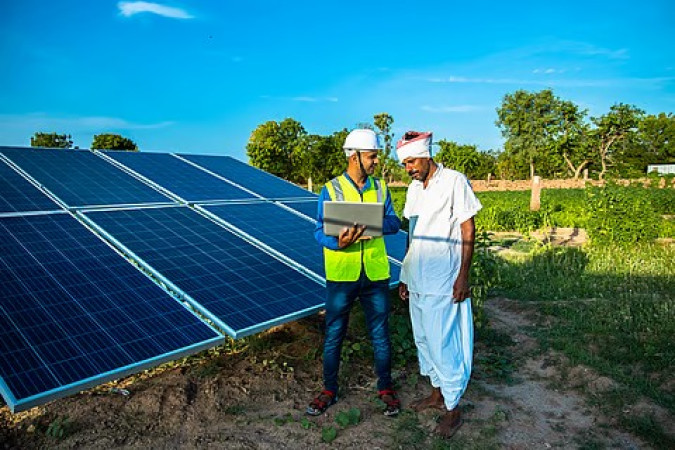
Follow India Renewable Energy News on WhatsApp for exclusive updates on clean energy news and insights
Powering Progress: How India’s Energy Sector is Driving a New Growth Era
Mar 19, 2026
The timeless Sanskrit phrase “Tamso Ma Jyotirgamaya”—meaning “lead us from darkness to light”—aptly reflects India’s transformation in the power sector. What was once a system marked by persistent shortages has, over the past decade, evolved into one of the world’s fastest-growing, diversified, and reform-oriented electricity markets.
As India strengthens its position as a global manufacturing hub, expands its digital economy, and advances as a clean energy leader, the power sector has emerged as a critical foundation for economic growth. Significant additions in generation and transmission capacity have sharply reduced energy shortages—from 4.2% in FY2013-14 to just 0.03% in FY2025-26.
The pace of capacity addition has been particularly notable. In FY2025-26 (up to January 2026), India added a record 52.53 GW of power capacity, surpassing the previous high of 34.05 GW in FY2024-25. At the same time, total electricity generation has nearly doubled—from 1,020 billion units in 2014 to 1,830 billion units in 2025. Rising per capita consumption, from 957 kWh to 1,460 kWh, reflects both improved access and strong economic activity. Today, India stands as the world’s third-largest producer and consumer of electricity.
Beyond capacity, grid resilience has seen major improvements. Peak demand touched a record 250 GW in the summer of 2024 and remained high at over 242 GW in FY2025-26. Unlike earlier years, such demand surges were managed efficiently, thanks to a robust and integrated national grid. With an inter-regional transfer capacity of around 120 GW, the “One Nation, One Grid, One Frequency” framework has enabled seamless power distribution across the country.
Government-led initiatives have played a crucial role in expanding access and modernizing infrastructure. Schemes like Deen Dayal Upadhyaya Gram Jyoti Yojana and Saubhagya have ensured electrification reaches every village and millions of households. Meanwhile, reforms such as separate connectivity for solar and non-solar hours at ISTS substations are enhancing grid efficiency.
Digital transformation is also reshaping the sector. Under the Revamped Distribution Sector Scheme (RDSS), large-scale deployment of smart prepaid meters is improving transparency and operational efficiency. As a result, AT&C losses have declined from 21.91% in 2021 to 15.04% in 2025, while the gap between cost and revenue has significantly narrowed.
Looking ahead, rising demand from data centers and emerging technologies will redefine energy consumption patterns. Data center capacity alone is expected to grow from 1.4 GW to 9 GW by 2030, potentially accounting for about 3% of the country’s electricity usage. Meeting this demand sustainably will require scaling up energy storage solutions such as pumped hydro and battery systems, alongside renewable energy expansion.
India is also making strategic moves in green hydrogen and nuclear energy. The National Green Hydrogen Mission aims to position the country as a global hub for clean fuels, while plans to achieve 100 GW of nuclear capacity by 2047 signal a strong commitment to a reliable, low-carbon energy mix. Policy initiatives like the SHANTI Act, 2025 are further enabling private sector participation in nuclear development.
As India moves toward its vision of Viksit Bharat, the focus will be on coordinated action—strengthening transmission networks, enhancing digital grid intelligence, expanding renewable capacity, and fostering cross-border electricity collaboration. A unified long-term roadmap will be key to building a resilient and future-ready power ecosystem.
In this context, the Bharat Electricity Summit 2026 in New Delhi holds special importance. With its theme centered on growth, sustainability, and global connectivity, the summit will bring together key stakeholders to showcase India’s leadership in energy transition, encourage policy dialogue, and attract investments.
India’s energy journey is no longer just about meeting demand—it is about enabling sustainable growth, driving innovation, and lighting the path for shared global prosperity.
Related News
Delhi Needs Faster Rooftop Solar and Battery Storage…
Delhi will need to accelerate the deployment of rooftop solar, battery energy storage,…
NHPC Strengthens Clean Energy Portfolio with 40-Year…
NHPC Limited has signed a long-term Power Purchase Agreement (PPA) with Chhattisgarh…
REC Commits Rs 5,000 Crore to Boost Renewable Energy…
REC Ltd. has signed a Memorandum of Understanding (MoU) with the Tripura Renewable…