Follow India Renewable Energy News on WhatsApp for exclusive updates on clean energy news and insights
China to End Export Tax Rebates on Solar PV Products from April 2026, Signalling Higher Global Prices
Jan 12, 2026
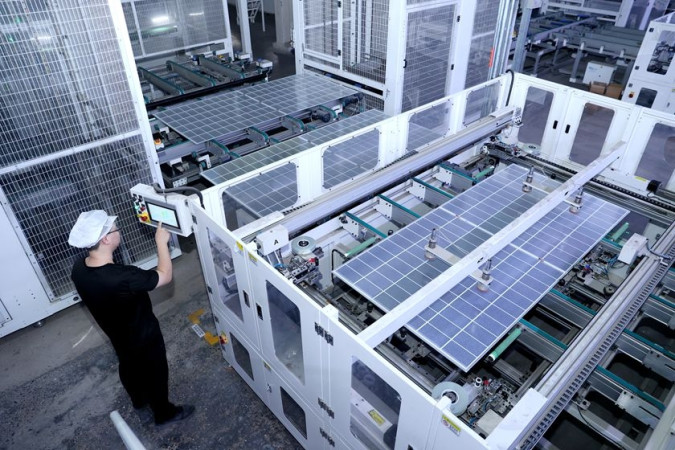
China has announced that it will abolish export tax rebates on solar photovoltaic (PV) products effective April 1, 2026, while also implementing a phased reduction in export rebates for battery products. The move is expected to push up global prices for solar modules and energy storage systems, with significant implications for import-dependent markets such as India.
In a notification issued by the Ministry of Finance, the Chinese government stated that VAT export rebates for photovoltaic and related products will be withdrawn from April 2026. At present, solar PV exports attract a 9% rebate, which had already been reduced from 13% in November 2024.
With the rebate removal, solar module prices are expected to rise sharply, particularly as manufacturers face additional cost pressures from recent increases in silver, aluminium, and copper prices. Market participants anticipate further price escalation in the coming weeks, alongside a near-term surge in exports as suppliers rush to ship products before the policy takes effect—an action likely to drive prices higher even before April 2026.
Over the longer term, the policy is expected to trigger industry consolidation within China’s solar PV sector, as smaller manufacturers that relied on export subsidies to remain competitive may be forced to exit the market.
According to the notified product list, the measure covers a wide range of solar products, including monocrystalline silicon wafers larger than 15.24 cm in diameter, across thicknesses above and below 220 micrometres, as well as unassembled solar cells and fully assembled photovoltaic modules.
On the energy storage front, China will reduce export tax rebates on battery products from 9% to 6?tween April 1 and December 31, 2026, followed by a complete withdrawal of rebates from January 1, 2027. The notification clarified that export consumption tax policies for applicable products will remain unchanged, with existing refund and exemption provisions continuing to apply.
The phased rollback is expected to result in gradual cost increases for lithium-ion batteries. Beyond Li-ion cells and battery packs, the affected product list also includes alternative storage technologies, such as all-vanadium redox flow batteries, as well as key upstream materials used in lithium-based chemistries, including lithium hexafluorophosphate, lithium manganate, lithium cobalt oxide, and lithium nickel cobalt manganese oxides.
For India, the policy is likely to translate into higher prices for solar cells and modules, as wafer costs rise. While India has achieved self-sufficiency in solar module manufacturing and is rapidly expanding domestic solar cell capacity, it remains heavily dependent on China for upstream inputs such as wafers and polysilicon.
In the battery energy storage system (BESS) segment, recent auctions have delivered record-low tariffs. However, the expected post-policy price increases could compress project economics and place additional pressure on developers, particularly for large-scale storage deployments.
Related News

Kalpa Power Secures 100 MWh BESS Manufacturing Capacity…
Energy management company Kalpa Power has signed a Memorandum of Understanding (MoU)…
Government Opens Global Bidding for 10 GWh ACC Battery…
The Ministry of Heavy Industries (MHI) has invited global bids for the establishment…
Hitachi Energy Wins 165 MW/330 MWh Battery Storage…
Hitachi Energy has secured its first Battery Energy Storage System (BESS)…