Follow India Renewable Energy News on WhatsApp for exclusive updates on clean energy news and insights
Delhi Needs Faster Rooftop Solar and Battery Storage Growth to Manage Rising Electricity Demand: IEEFA-Ember
Aug 09, 2026
Delhi will need to accelerate the deployment of rooftop solar, battery energy storage, energy-efficiency measures and demand-side flexibility to meet its rapidly increasing electricity requirements while keeping its power sector on a lower-carbon pathway, according to a new study by the Institute for Energy Economics and Financial Analysis (IEEFA) and Ember. The report, titled “Delhi’s electricity transition challenges and opportunities: A SCOPE study”, highlights the need for a transition strategy tailored to the capital's unique constraints, particularly limited land availability and its heavy dependence on electricity procured from outside the city.
Delhi's electricity system has achieved significant improvements in reliability and distribution-sector performance, allowing the capital to manage record levels of peak demand in recent years. However, electricity consumption is continuing to rise, driven by increasing cooling requirements, commercial activity, urbanisation and the electrification of transport. The changing shape of demand is also becoming important, with higher electricity consumption extending into evening and night-time periods when solar generation is unavailable, increasing the importance of flexible resources such as battery storage.
Unlike many Indian states with large areas available for utility-scale renewable-energy projects, Delhi has very limited scope for developing large solar or wind generation facilities within its geographical boundaries. The city therefore relies substantially on electricity allocated from central generating stations and power procured from neighbouring states and external markets. As of June 2026, Delhi had approximately 7,544 MW of allocated generation capacity, highlighting the importance of long-term procurement strategies and regional grid connectivity for maintaining supply security.
The study estimates that Delhi's energy requirement reached 38,482 million units (MU) during FY2026, equivalent to approximately 2.2% of India's total electricity requirement. Residential consumers accounted for more than half of the city's electricity consumption, making household demand a particularly important factor in determining the future shape of Delhi's power system. Rising appliance ownership, air-conditioning use and electrification of mobility could place further pressure on the city's distribution network, particularly during periods of extreme summer temperatures.
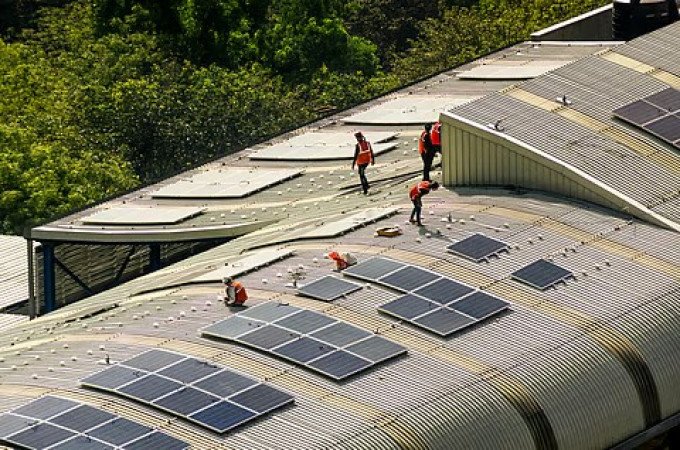
Rooftop solar is identified as one of Delhi's most practical avenues for increasing renewable-energy generation within the city. Installed distributed solar capacity reached approximately 446 MW by June 2026. Unlike large solar parks, rooftop systems can be deployed directly at homes, commercial buildings, institutions and industrial facilities, allowing electricity to be generated closer to the point of consumption while making productive use of otherwise underutilised rooftop space.
The report indicates that rooftop solar deployment could be accelerated by simplifying approval procedures, expanding and strengthening net-metering arrangements and maintaining consumer incentives under programmes such as the Delhi Solar Energy Policy and the Pradhan Mantri Surya Ghar: Muft Bijli Yojana. Wider adoption would allow households and commercial consumers to offset a portion of their grid electricity consumption while contributing to the city's overall renewable-energy capacity.
However, rooftop solar alone cannot address Delhi's growing evening and night-time electricity demand. Solar generation is naturally concentrated during daylight hours, while air-conditioning, household appliances, commercial activity and electric-vehicle charging can continue into the evening. Battery energy storage systems could help bridge this timing gap by storing surplus solar electricity during the day and supplying it when demand rises after sunset.
Energy storage could also provide additional grid services, including peak-demand management, balancing and improved system flexibility. As the share of variable renewable generation increases, batteries and other flexible resources can help distribution utilities manage short-term fluctuations in supply and demand. For Delhi, where opportunities to build new large-scale generation within the city are limited, such flexibility could become particularly valuable.
Demand-side management is another important component of the transition. Smarter electricity pricing, including time-of-day tariffs aligned with periods of abundant solar generation, could encourage consumers to shift flexible electricity consumption towards daytime hours. Electric-vehicle charging, water heating, commercial cooling and certain industrial processes are examples of loads that can potentially be shifted without significantly affecting consumers' overall electricity services.
Delhi has already begun introducing measures that could support this transition. The city has implemented Green Energy Open Access regulations, approved a pilot for peer-to-peer trading of rooftop solar electricity and introduced an electric-vehicle policy aimed at increasing vehicle electrification and charging infrastructure. These initiatives could provide additional avenues for consumers and businesses to participate in the clean-energy market rather than remaining solely passive electricity users.
The IEEFA-Ember study also identifies improvements in building energy efficiency and smart-meter deployment as important measures for controlling future demand. Better building design, efficient cooling systems and energy-management technologies can reduce electricity consumption without compromising comfort. Smart meters, meanwhile, can provide more detailed consumption information and create the infrastructure required for advanced tariffs and future demand-response programmes.
Tanya Rana, Energy Analyst, South Asia at IEEFA and lead author of the report, said Delhi requires a different energy-transition pathway from most Indian states because large-scale renewable-energy development within the city's boundaries is constrained. Instead, she highlighted the importance of combining clean-power procurement with rooftop solar, storage, energy efficiency, demand-side flexibility and participation in electricity markets.
Ruchita Shah, Energy Analyst, Asia at Ember and co-author of the study, said Delhi's existing strengths in distribution-sector performance, power procurement and distributed renewable energy provide a foundation for the next stage of the transition. She emphasised the need to expand rooftop solar and energy storage while adopting longer-term procurement strategies capable of meeting demand arising from wider electrification.
The study also recommends greater development of battery storage, expanded energy-efficiency measures, increased smart-meter penetration, solar-hour-aligned time-of-day tariffs and stronger participation in green electricity market segments. Further development of peer-to-peer electricity trading could also create new opportunities for rooftop solar owners to participate more actively in the power system.
For Delhi, the challenge is therefore not simply to add more renewable-energy capacity but to build a power system capable of matching clean electricity supply with an increasingly complex demand profile. With limited land for large-scale generation and growing electricity requirements, the capital will need to combine rooftop solar, external renewable-energy procurement, battery storage, efficient buildings, flexible electricity consumption and modern power-market mechanisms.
The findings underline that Delhi's next phase of decarbonisation will depend as much on how electricity is generated, stored and consumed as on the total amount of renewable capacity added. A coordinated expansion of distributed solar and storage, supported by efficient buildings, smart tariffs and flexible demand, could allow the capital to accommodate rising electricity consumption while reducing its dependence on carbon-intensive power and strengthening long-term energy security.
Related News
Delhi Needs Faster Rooftop Solar and Battery Storage…
Delhi will need to accelerate the deployment of rooftop solar, battery energy storage,…
NHPC Strengthens Clean Energy Portfolio with 40-Year…
NHPC Limited has signed a long-term Power Purchase Agreement (PPA) with Chhattisgarh…

REC Commits Rs 5,000 Crore to Boost Renewable Energy…
REC Ltd. has signed a Memorandum of Understanding (MoU) with the Tripura Renewable…