Follow India Renewable Energy News on WhatsApp for exclusive updates on clean energy news and insights
NSPCL Commissions 15 MW Bhilai Floating Solar Plant; NTPC Completes 176 MW Ramagundam Solar Project
Jul 06, 2026
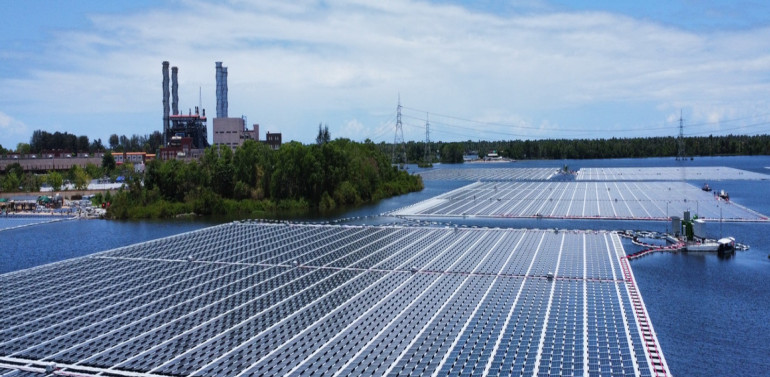
NTPC-SAIL Power Company Limited (NSPCL) has fully commissioned its 15 MW floating solar power project at Bhilai in Chhattisgarh, marking the completion of another renewable energy asset within the NTPC Group's expanding clean energy portfolio. The company declared commercial operation of the final 5 MW module (Island-2) on June 24, 2026, bringing the entire floating solar installation into service.
The Bhilai Floating Solar Power Station has been developed by NSPCL, a joint venture between NTPC Limited and Steel Authority of India Limited (SAIL). The project is designed to generate clean electricity by installing solar photovoltaic panels on a water body, eliminating the need for large tracts of land. Floating solar technology is increasingly being adopted across India as it enables efficient use of reservoirs, reduces water evaporation, and can improve solar panel performance due to the cooling effect of water.
Alongside the Bhilai project, NTPC has also announced the commissioning of the remaining 41.6 MW capacity of its 176 MW Solar PV Project at Ramagundam in Telangana. Earlier phases of the project, comprising 100 MW and 34.4 MW, were commissioned in May 2026. With the final phase now operational, the entire 176 MW solar project has entered commercial operation.
The two project milestones further strengthen NTPC's renewable energy generation capacity at a time when the company is accelerating investments in utility-scale solar, floating solar, wind, battery energy storage, and green hydrogen projects. According to the company, following these latest commissioning activities, the NTPC Group's total installed power generation capacity has increased to 90,904 MW, while its commercial operating capacity has reached 89,824 MW.
Floating solar projects are becoming an important component of India's renewable energy strategy, particularly in states where land availability is limited or expensive. By utilizing existing reservoirs, cooling ponds, and other water bodies, these projects help optimize infrastructure while minimizing environmental impact. They also complement conventional ground-mounted solar installations and support the country's broader transition toward low-carbon electricity generation.
NTPC remains India's largest integrated power utility and has significantly expanded its renewable energy portfolio in recent years. The company has committed to developing large-scale renewable energy capacity as part of its long-term objective to support India's clean energy transition and contribute toward the country's target of achieving 500 GW of non-fossil fuel-based installed electricity capacity by 2030. The commissioning of both the Bhilai Floating Solar Power Station and the Ramagundam Solar PV Project represents another step in advancing that objective while enhancing the reliability and diversity of NTPC's generation portfolio.
Related News

Himachal Pradesh Commissions 500 kW Solar Plant in…
Himachal Pradesh has strengthened its clean energy and rural development initiatives…
SJVN Commissions India's Largest 1 GW Single-Site…
State-owned power producer SJVN Limited has commissioned a 1,000 MW (1 GW) Domestic…
JSW Breaks Ground on Green Steel Plant in Andhra Pradesh…
Andhra Pradesh has strengthened its position as an emerging hub for sustainable…