Follow India Renewable Energy News on WhatsApp for exclusive updates on clean energy news and insights
Design Automation Software Set to Bridge Global Engineering Talent Gap in Renewable Energy
Oct 29, 2025
A global shortage of skilled engineers has emerged as one of the biggest challenges to scaling renewable energy infrastructure. As countries race toward Net Zero 2050, innovative design automation software such as AutoPV is proving critical in addressing this gap — enhancing productivity, accelerating project execution, and enabling engineers to deliver more with less.
According to the International Energy Agency (IEA), the transition to clean energy will require the creation of nearly 30 million new jobs by 2030, yet the world is expected to fall short by around seven million skilled professionals. The shortage spans key disciplines including engineering, project development, and technical installation, slowing the pace of global renewable expansion.
In the utility-scale solar sector alone, over USD 12 billion will be invested in design activities over the next five years — equivalent to 12,000 work-years of engineering labor.
“This imbalance underscores the urgent need for automation-driven engineering tools to dramatically boost output and efficiency,” said Paul Nel, CEO of 7SecondSolar. “Software like AutoPV can cut months off project timelines by producing construction-ready outputs for multiple designs within hours. It enables engineers to focus on optimization and innovation instead of repetitive manual work,” he explained.
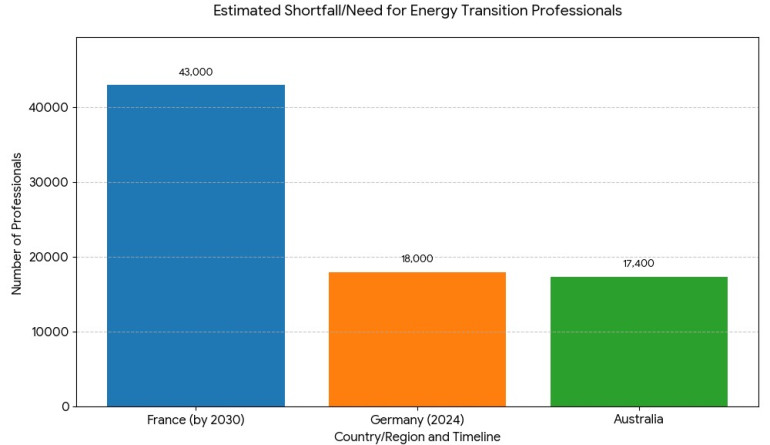
The skills shortage is evident worldwide. South Africa has fewer than 40,000 registered engineers, while Germany left more than 18,000 energy transition-related roles unfilled in 2024. France will need to recruit 43,000 specialists by 2030 to modernize its grid, and Australia faces a shortfall of nearly 17,400 energy professionals.
These figures highlight a growing reality — that human capacity, not capital, has become the biggest constraint in renewable deployment.
Global solar PV installations are projected to exceed 7 terawatts (TW) by 2030, representing about 65% of the 11 TW renewable energy target set at COP28. Meeting this scale will require not just more engineers, but smarter engineering, powered by computational automation.
Experts also stress the need for education reform. Studies reveal that 68% of global energy programs still focus on fossil fuels, while only 32% cover renewable technologies. As clean energy becomes dominant, universities must integrate automation and computational design into engineering curricula to align with modern project needs.
“The energy sector can no longer afford months-long manual design processes for utility-scale projects,” Nel added. “Since training millions of new engineers by 2030 is unrealistic, the solution lies in amplifying the productivity of each engineer through automation — ensuring renewable projects remain both bankable and rapidly deployable.”
Related News

NIT Rourkela Develops AI-Powered Smart Monitoring…
Researchers at the National Institute of Technology (NIT) Rourkela have developed…

INVT Electric India Unveils Advanced Industrial Automation…
INVT Electric India showcased its latest portfolio of industrial automation and…

Andhra Pradesh's Proposed ‘Deemed Distribution Licensee’…
The Andhra Pradesh Government's proposal to grant "deemed distribution licensee"…