Follow India Renewable Energy News on WhatsApp for exclusive updates on clean energy news and insights
India Accelerates EV Adoption with a Multi-Fuel Pathway, Reveals IESA e-Mobility Report
Oct 27, 2025
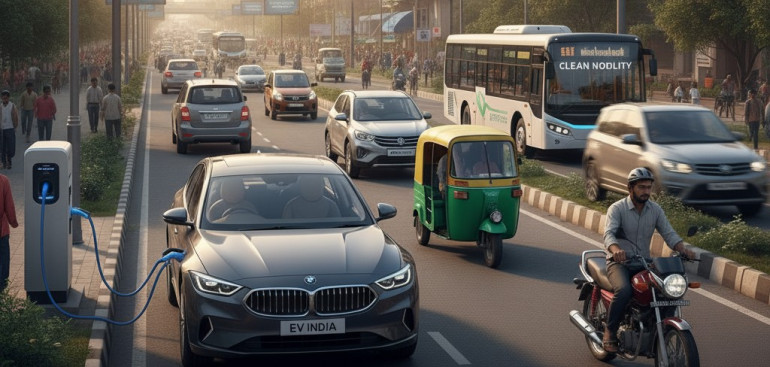
India’s transition to sustainable mobility is gaining pace, driven by a diverse multi-fuel approach, strong policy backing, and state-level initiatives, according to the latest Automotive Electrification in India Market Report released by the India Energy Storage Alliance (IESA) through its India Electric Mobility Council (IEMC).
As the world’s fourth-largest automobile producer, India is strategically positioned to emerge as a global hub in the evolving automotive landscape. The report notes that while petrol and diesel vehicles still dominate Indian roads, the momentum is steadily shifting toward electric, hybrid, CNG, flex-fuel, and hydrogen-powered vehicles, signalling that clean mobility is no longer aspirational but achievable.
The study highlights proactive roles played by state governments, which are rolling out EV manufacturing incentives, charging infrastructure projects, and dedicated mobility clusters. This collaborative approach between the Centre and states is accelerating the nation’s e-mobility ecosystem.
Under the draft Corporate Average Fuel Efficiency (CAFÉ 3) norms, effective from April 1, 2027, manufacturers will receive volume-based incentives for increasing the sales of zero- and low-emission vehicles, further reinforcing the policy thrust toward sustainable transport.
Commenting on the findings, Debmalya Sen, President of IESA, stated, “Policy direction is the cornerstone of India’s shift toward green mobility. While EV adoption varies across states, regions such as Uttar Pradesh, Maharashtra, Karnataka, and Tamil Nadu account for over half of the country’s EV sales.”
He further added that India’s multi-path strategy — where some states advance directly toward Zero Emission Vehicle (ZEV) adoption while others integrate alternative fuels — reflects diverse market readiness and regional priorities.
As India moves closer to its Net Zero goals, the report underscores the importance of balanced demand- and supply-side measures, along with technology-neutral policies, to foster the entire spectrum of environmentally sustainable mobility solutions.
Related News
NueGo Adds New Electric Bus Routes Across India, Expanding…
NueGo, the electric intercity bus brand operated by GreenCell Mobility and backed…
Sona Comstar and DENSO Form Two Joint Ventures to…
Sona BLW Precision Forgings Ltd. (Sona Comstar) has entered into definitive joint…
Kazam Rolls Out ‘EV-Ready Ghar’ Initiative to Strengthen…
EV charging and energy management company Kazam has launched its nationwide 'EV-Ready…