Follow India Renewable Energy News on WhatsApp for exclusive updates on clean energy news and insights
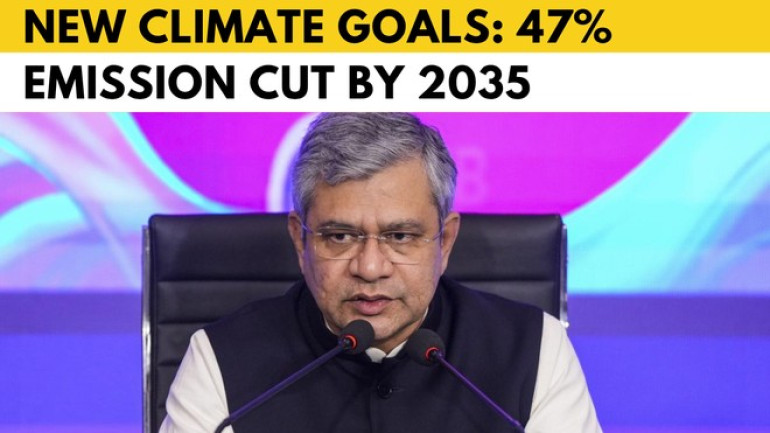
India Clears Updated Climate Targets: 47% Emission Intensity Cut and 60% Clean Power by 2035
Mar 27, 2026
India has strengthened its climate roadmap with the Union Cabinet approving an updated set of Nationally Determined Contributions (NDCs) for the 2031–2035 period under the United Nations Framework Convention on Climate Change. The revised commitments signal a step-up in ambition as the country aligns its development trajectory with long-term sustainability goals.
Under the updated framework, India has committed to reducing the emissions intensity of its GDP by 47 percent from 2005 levels by 2035. This marks a notable progression from earlier targets, especially considering that the country has already achieved a 36 percent reduction between 2005 and 2020, reflecting consistent efforts to decouple economic growth from carbon emissions.
In the energy sector, the country aims to ensure that 60 percent of its total installed electricity capacity comes from non-fossil fuel sources by 2035. India has already made significant progress on this front, surpassing its earlier 40 percent target well ahead of schedule and reaching over 50 percent non-fossil capacity as of early 2026.
The updated NDCs also expand India’s carbon sink ambitions, with a target of creating an additional 3.5 to 4 billion tonnes of CO? equivalent through enhanced forest and tree cover. This builds on existing progress in afforestation and ecosystem restoration, which has already contributed substantially to carbon absorption.
These commitments are part of India’s broader climate strategy under the Paris Agreement and are aligned with its long-term objective of achieving net-zero emissions by 2070. They also support the national vision of becoming a developed economy under the Viksit Bharat 2047 framework.
The government highlighted that the targets will be backed by a wide range of policy measures, including expansion of renewable energy, development of battery storage systems, green hydrogen initiatives, and strengthening of grid infrastructure. Global collaborations such as the International Solar Alliance and other climate-focused partnerships are also expected to play a key role in implementation.
Beyond emission reduction, India continues to place strong emphasis on climate adaptation through initiatives like coastal protection programs, glacier monitoring, and heat action plans. These efforts are being implemented through national and state-level climate strategies to enhance resilience against climate risks.
Overall, the updated NDCs reflect India’s attempt to balance rapid economic growth with environmental responsibility, reinforcing its position as a key player in global climate action while addressing domestic energy and development needs.
Related News

Tamil Nadu Unveils Rs 1 Lakh Rooftop Solar Subsidy…
The Tamil Nadu Government has announced a new rooftop solar subsidy of up to Rs…

MERC Clears MSEDCL’s 2,269 MW Distributed Solar Procurement…
The Maharashtra Electricity Regulatory Commission (MERC) has approved the tariffs…

OERC Proposes New 10 MW Distributed Renewable Energy…
The Odisha Electricity Regulatory Commission (OERC) has proposed a new regulatory…