Follow India Renewable Energy News on WhatsApp for exclusive updates on clean energy news and insights
India–Oman CEPA Opens Gateway for Indian Green Energy Investments
Dec 21, 2025
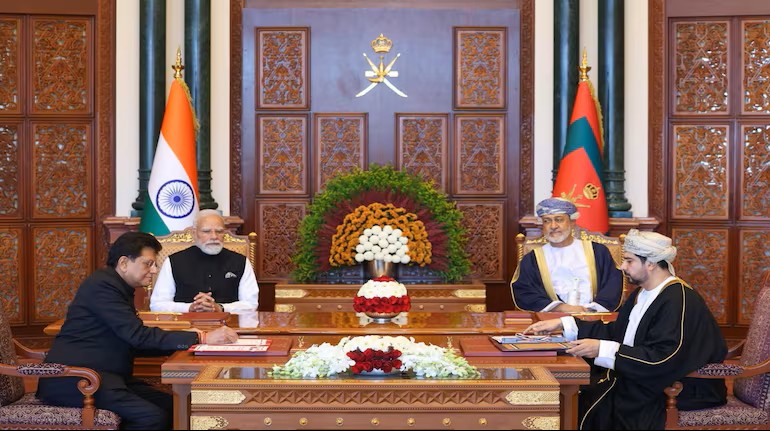
Policy certainty on tariffs and enhanced labour mobility under the India–Oman Comprehensive Economic Partnership Agreement (CEPA) is expected to encourage Indian companies to establish operations in Oman, particularly in energy-intensive green sectors such as green steel, green hydrogen, ammonia, and advanced manufacturing, Commerce and Industry Minister Piyush Goyal said on Friday.
Speaking after the signing of the CEPA, Goyal noted that Oman’s availability of natural resources and proximity to India make it a strategic base for Indian firms targeting global markets. “Companies that depend on natural resources are logically looking at Oman. A large green steel project by an Indian company is already coming up there,” he said. The agreement is expected to become operational within the next three months.
The minister said Indian investments in Oman would generate employment opportunities for Indian workers and highlighted strong interest in sectors such as marble processing, education, healthcare, and clean manufacturing. He added that Oman’s large marble reserves offer significant scope for downstream processing investments by Indian firms.
Mobility Boost for Indian Workforce
A key feature of the CEPA is the enhanced mobility framework, which allows Indian companies operating in Oman to staff up to 50 percent of their workforce with Indian nationals under the Intra-Corporate Transfer (ICT) route, up from the earlier limit of 20 percent. Additionally, ICT personnel can now stay in Oman for up to four years, compared to just 90 days earlier.
These provisions are expected to benefit nearly 6,000 India–Oman joint ventures, enabling greater staffing flexibility, smoother service delivery, and improved access to regional contracts. Oman has also invited Indian firms to invest in its Special Economic Zones and Free Trade Zones.
Goyal added that the agreement ensures Indian investors can primarily employ Indian workers, helping generate more domestic employment. He also revealed growing interest in battery manufacturing projects being set up by Indian companies in Oman.
Strong Interest Across Sectors
Highlighting existing partnerships, Goyal pointed out that Amity University already operates multiple educational facilities in Oman, while Apollo Hospitals has established a strong presence in the healthcare sector. Both sectors offer substantial growth potential. He also noted that Oman Dairy has expressed interest in forming a joint venture with Amul.
Commerce Secretary Rajesh Agrawal emphasized Oman’s geographic advantage, stating that the country is just two hours from India, making trade more efficient. “Tariff predictability on 98 percent of tariff lines and a trusted partner country significantly strengthens India’s business interests,” he said.
Services, Electronics to Gain
Agrawal said the services sector would be a major beneficiary of the CEPA. While Oman is a relatively smaller goods market, its services imports are valued at $13 billion, with India’s share currently at 5.3 percent or about $665 million. Oman has permitted 100 percent foreign direct investment from India in most services sectors and committed market access across 127 services sub-sectors.
Electronics was identified as another high-potential area. Oman imports electronics worth around $3 billion annually, of which India’s share is approximately $123 million. “Electronics is on track to become India’s second-largest export sector, and Oman will be an important market as production scales up,” Agrawal said.
Trade Liberalisation Under CEPA
The India–Oman CEPA provides zero-duty access on 98.08 percent of tariff lines, covering 99.38 percent of India’s exports to Oman. In return, India will offer tariff concessions on 77 percent of tariff lines, accounting for 94 percent of Oman’s exports to India. While most tariff reductions will take effect immediately, some products—particularly in petrochemicals—will see phased reductions once the agreement comes into force.
Related News

International Solar Alliance Seeks Consultants to…
The International Solar Alliance (ISA) has invited bids from eligible consulting…
Hinduja Renewables Crosses 4 TWh Green Power Generation…
Hinduja Renewables Energy Private Limited (HREPL), the renewable energy arm of the…
Mahavitaran CMD Lokesh Chandra Honoured for Driving…
Lokesh Chandra, Chairman and Managing Director of Maharashtra State Electricity…