Follow India Renewable Energy News on WhatsApp for exclusive updates on clean energy news and insights
Innovation and Collaboration Propel India’s Energy Efficiency Vision at AEEE-Energise 2025
Nov 11, 2025
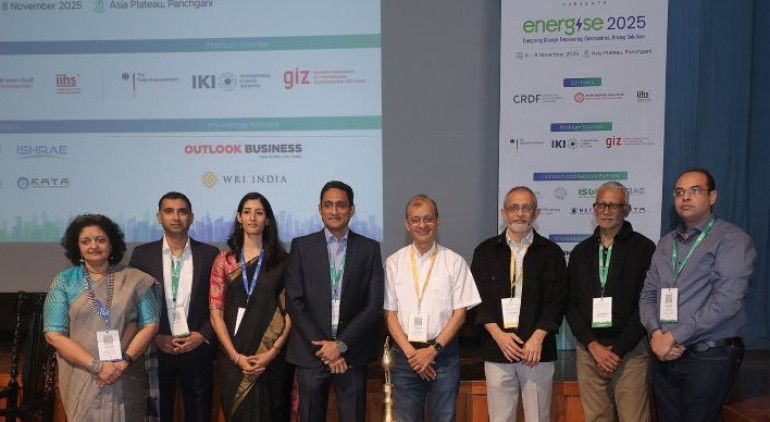
The fourth edition of AEEE-Energise 2025 gathered over 200 experts, policymakers, researchers, and students in Panchgani for three days of intensive research presentations, workshops, and dialogues aimed at accelerating India’s clean energy, energy efficiency, and decarbonisation goals.
Organised by the Alliance for an Energy Efficient Economy (AEEE) in partnership with the CEPT Research and Development Foundation (CRDF), Indian Institute of Technology Delhi (IIT Delhi), and the Indian Institute for Human Settlements (IIHS), the residential conference reinforced the vital role of energy efficiency in building a resilient, inclusive, and low-carbon economy.
“AEEE-Energise 2025 shows that India’s clean energy transformation is powered not only by technology but also by data, innovation, and people. When research, policy, and markets align, energy efficiency becomes a catalyst for competitiveness, resilience, and equity in India’s growth,” said Dr. Satish Kumar, President and Executive Director, AEEE, and Convenor of Energise 2025.
The event showcased over 80 research papers, complemented by interactive workshops, peer-led discussions, and expert dialogues on emerging themes in the energy and climate space.
Key Highlights
One of the major launches was the Geospatial Open Building Stack (GOBS) — India’s first open-data initiative designed to map the nation’s built environment. GOBS provides detailed and verifiable insights into building density, materials, and energy usage, empowering planners and policymakers to model energy demand, identify high-consumption zones, and design climate-resilient, resource-efficient cities through data-driven urban planning.
Another significant release was the issue brief “Mapping Demand Flexibility Service Providers for India’s Green Grid,” which delivers the country’s first comprehensive overview of the emerging Demand Flexibility (DF) market — a key enabler of grid resilience and renewable integration.
Additionally, the conference marked the launch of Di-Carb (Data-driven Integrated Carbon Metrics for Buildings) Phase 2, advancing research on embodied and operational carbon in construction to promote low-carbon design practices across India’s building sector.
Exploring the Future of Intelligence and Energy
A special session with science journalist and author Anil Ananthaswamy explored the convergence of consciousness, artificial intelligence (AI), and energy. Drawing insights from his acclaimed works The Man Who Wasn’t There and Why Machines Learn, Ananthaswamy invited participants to reimagine how both human and artificial intelligence can foster more mindful, energy-conscious societies.
Driving a Just and Sustainable Transition
Throughout the sessions, experts discussed critical topics such as demand flexibility for grid stability, district cooling for urban sustainability, inclusive and equitable energy transitions, and innovative financing for decarbonisation. The collective consensus underscored the importance of integrating technology, governance, and behavioural change to achieve India’s long-term clean energy ambitions.
The event also spotlighted young researchers and emerging professionals, emphasizing mentorship and collaboration as key to cultivating the next generation of clean energy leaders.
Related News
NIT Rourkela Develops AI-Powered Smart Monitoring…
Researchers at the National Institute of Technology (NIT) Rourkela have developed…
INVT Electric India Unveils Advanced Industrial Automation…
INVT Electric India showcased its latest portfolio of industrial automation and…

Andhra Pradesh's Proposed ‘Deemed Distribution Licensee’…
The Andhra Pradesh Government's proposal to grant "deemed distribution licensee"…