Follow India Renewable Energy News on WhatsApp for exclusive updates on clean energy news and insights
MNRE Minister Pralhad Joshi Unveils 240 TPD Biomass Pellet Facility in Rewari, Haryana
Nov 26, 2025
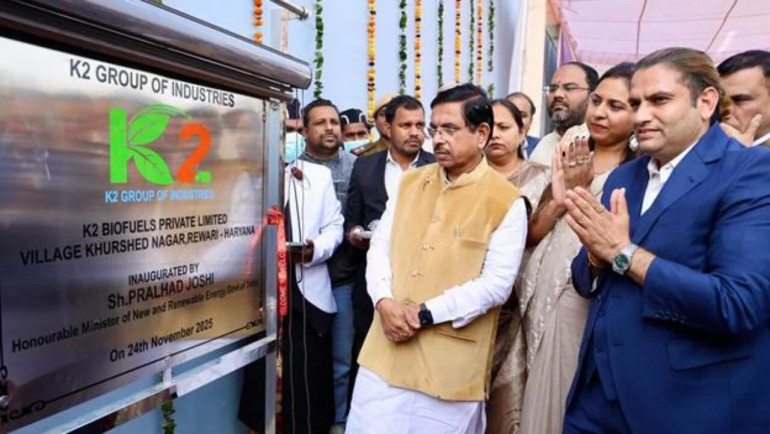
Union Minister for New and Renewable Energy, Pralhad Joshi, has inaugurated a modern 240-tonne-per-day biomass pellet plant in Rewari, Haryana, marking a significant boost to clean energy efforts and a strategic step to curb stubble burning.
The facility will convert locally available agricultural residues—including paddy straw, mustard straw and cotton stalks—into biomass pellets for co-firing in thermal power plants. This initiative is expected to reduce air pollution, lower carbon emissions and create rural livelihood opportunities, while offering farmers an additional source of income.
Joshi termed the project a major move toward achieving Prime Minister Narendra Modi’s long-term vision of a sustainable and energy-secure India. He highlighted that the central government recently issued a comprehensive policy mandating the co-firing of biomass pellets or torrefied MSW charcoal in all coal-based thermal power stations. Under this policy, plants nationwide must co-fire at least 5% biomass (by weight), while units in the Delhi-NCR region will operate with a 7% blend.
For NCR power stations, the policy requires that at least half of the biomass supply comes from local paddy residue, ensuring a sustainable value chain and helping address the recurring challenge of stubble burning. The Minister also noted ongoing efforts to strengthen source segregation and regulatory oversight to support the production of MSW-derived charcoal, given the complexities of managing mixed and wet municipal waste.
Reflecting on the Centre’s continued support for Haryana, Joshi said that major infrastructure and clean energy initiatives are reshaping the state’s development trajectory. He stated that India has nearly doubled its power generation capacity in the last decade, becoming a net exporter of electricity, and that Haryana—with over 12 GW of existing capacity—is on course to reach 24 GW in the coming years.
Sharing the State’s renewable energy progress, the Minister noted that Haryana now has more than 2.8 GW of installed clean energy capacity, including 2.4 GW of solar power. Over 2 lakh households have registered under the PM Surya Ghar Muft Bijli Yojana, and more than 45,000 homes have already installed rooftop solar systems, significantly reducing electricity bills.
Under the PM-KUSUM scheme, Haryana has commissioned 18.61 MW under Component A and installed over 1.74 lakh solar pumps, enabling farmers to irrigate using solar power instead of diesel. Joshi described this shift as a major empowerment of farmers, who are increasingly becoming producers of clean energy.
Joshi also highlighted Haryana’s pioneering role in green hydrogen, with multiple early-stage projects emerging in Hisar, Panipat and Jhajjar. The state’s biomass potential of over 1,350 MW and nearly 49 MW of waste-to-energy capacity across 26 plants further position Haryana as a key player in India’s clean-fuel transformation.
Related News
TERI Reintroduces Biomass Gasifier as Low-Cost Alternative…
The Energy and Resources Institute has revived its biomass gasifier technology to…

ISMA Supports PM Modi’s Biofuel Push to Strengthen…
The Indian Sugar and Bio-Energy Manufacturers Association (ISMA) has expressed strong…
Organic Recycling Systems Ltd. (ORSL) and SLPP Re-New…
Organic Recycling Systems Ltd. (ORSL) has entered into a strategic Memorandum of…