Follow India Renewable Energy News on WhatsApp for exclusive updates on clean energy news and insights
Nash Energy Launches 2 GWh Automated Battery Pack Manufacturing Facility in Karnataka
Jan 19, 2026
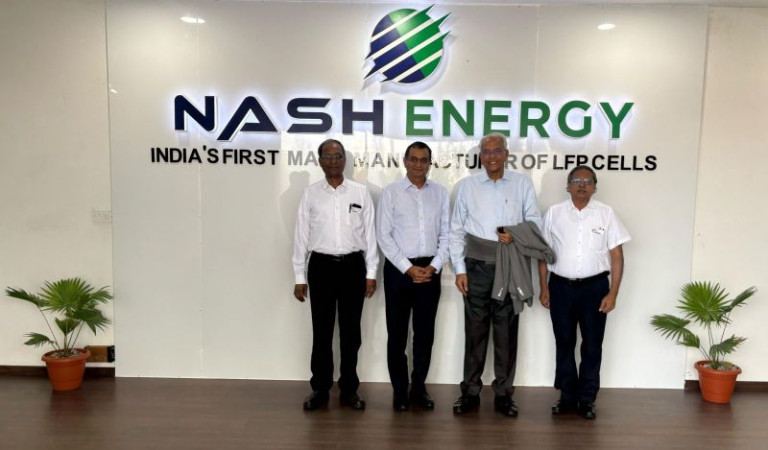
Bengaluru-based lithium-ion battery solutions provider Nash Energy has commissioned a fully automated prismatic battery pack manufacturing line with an annual capacity of 2 GWh at its facility in Dobbspet, Karnataka.
According to the company, the newly operational production line is capable of manufacturing battery packs across multiple form factors, with capacities ranging from 100 Ah to 314 Ah. This facility represents the first phase of Nash Energy’s long-term plan to scale up battery pack manufacturing capacity to 10 GWh over the next five years.
Prismatic battery packs use flat, rectangular lithium-ion cells arranged in stacked configurations within rigid metal enclosures. This design allows efficient space utilization and high energy density, making such batteries well suited for applications including electric vehicles (EVs) and battery energy storage systems (BESS).
The Karnataka facility will primarily serve demand from the BESS segment, electric mobility applications such as electric buses and trucks, and material handling equipment. Nash Energy stated that the automated line has been designed to support consistent quality and scalable production for diverse end-use requirements.
In addition to manufacturing expansion, the company is setting up a dedicated engineering centre in India to work alongside its existing research and development operations in Japan, strengthening its product development and localization capabilities.
In July 2025, Nash Energy had entered into a memorandum of understanding with US-based rechargeable cell developer Rincell to collaborate on the sale and manufacturing of advanced nickel-manganese-cobalt (NMC) battery cells in India. As part of the agreement, Rincell is expected to transfer its high C-rate cell technology to Nash Energy.
Lithium-ion batteries continue to dominate the energy storage market due to their long operational life, high efficiency, strong energy density, and rapid power delivery. However, supply chain disruptions during 2021 and 2022, along with geopolitical tensions, have raised concerns over cost volatility and material availability. According to the International Renewable Energy Agency’s report “Sodium-ion Batteries: A Technology Brief,” these challenges have accelerated efforts across the industry to diversify battery chemistries and reduce reliance on lithium and other critical raw materials.
Related News

Navitas Solar and Caelux Partner to Manufacture 5…
Indian solar module manufacturer Navitas Solar has entered into a five-year strategic…
Avaada Joins ALMM List-II with 610 MW TOPCon Cell…
India's domestic solar manufacturing ecosystem has received another boost as the…

Rayzon Solar Partners with Caelux to Develop 5 GW…
Indian photovoltaic manufacturer Rayzon Solar has entered into a strategic five-year…