Follow India Renewable Energy News on WhatsApp for exclusive updates on clean energy news and insights
US Announces Exit from Key Global Climate and Clean Energy Institutions Under Trump Administration
Jan 10, 2026
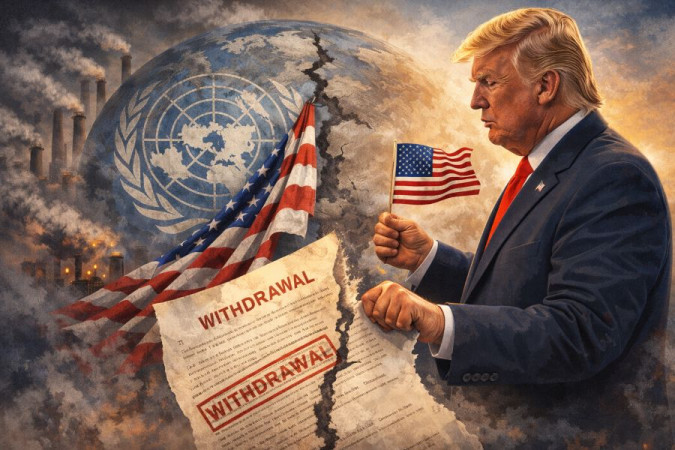
The White House has confirmed that the United States will withdraw funding and membership from multiple international organizations, including several that play central roles in global climate action and renewable energy cooperation.
According to the announcement, the US will exit 35 non-United Nations bodies and 31 UN-affiliated organizations, which the administration has determined are no longer aligned with national priorities. Among the entities affected are the UN Framework Convention on Climate Change (UNFCCC), the International Renewable Energy Agency (IRENA), the International Solar Alliance (ISA), UN Energy, the Renewable Energy Policy Network for the 21st Century (REN21), and the 24/7 Carbon-Free Energy Compact.
The decision follows a comprehensive review conducted by the Secretary of State, who assessed all international organizations, treaties, and agreements in which the US participates or provides financial support. Based on these findings, President Donald Trump has directed all federal departments and agencies to initiate immediate withdrawal procedures from the identified institutions.
IRENA serves as a global platform promoting the accelerated deployment of renewable energy technologies, including solar, wind, hydropower, bioenergy, geothermal, and ocean energy. The International Solar Alliance, spearheaded by India and launched alongside COP21 in Paris in 2015, has grown to include over 100 signatory countries, with more than 90 full members. The alliance aims to mobilize $1 trillion in solar investments by 2030 while reducing technology and financing costs in solar markets worldwide.
Reacting to the US withdrawal from UNFCCC-related frameworks, Simon Stiell, Executive Secretary of the UNFCCC, expressed strong concern over the move. He noted that the United States played a foundational role in shaping both the UNFCCC and the Paris Agreement, emphasizing that the frameworks were originally designed to serve US national and economic interests. Stiell warned that stepping back from international climate cooperation and science could undermine the US economy, describing the decision as a “colossal own goal.”
The announcement signals a broader shift in US policy away from multilateral climate engagement. Throughout 2025, the Trump administration initiated several measures domestically to scale back federal support for renewable energy.
In July, President Trump signed an executive order instructing the US Treasury Department to end clean electricity production and investment tax credits for wind and solar projects. The order also enforced stricter foreign entity-of-concern provisions outlined in the One Big Beautiful Bill Act, further tightening regulatory conditions for renewable energy investments.
The move marks a significant recalibration of the United States’ role in global climate governance and clean energy collaboration.
Related News

International Solar Alliance Seeks Consultants to…
The International Solar Alliance (ISA) has invited bids from eligible consulting…
Hinduja Renewables Crosses 4 TWh Green Power Generation…
Hinduja Renewables Energy Private Limited (HREPL), the renewable energy arm of the…

Mahavitaran CMD Lokesh Chandra Honoured for Driving…
Lokesh Chandra, Chairman and Managing Director of Maharashtra State Electricity…