Follow India Renewable Energy News on WhatsApp for exclusive updates on clean energy news and insights
Vikram Solar Chairman Weighs US Expansion, Dismisses Gloom Around Renewable Sector
Dec 29, 2025
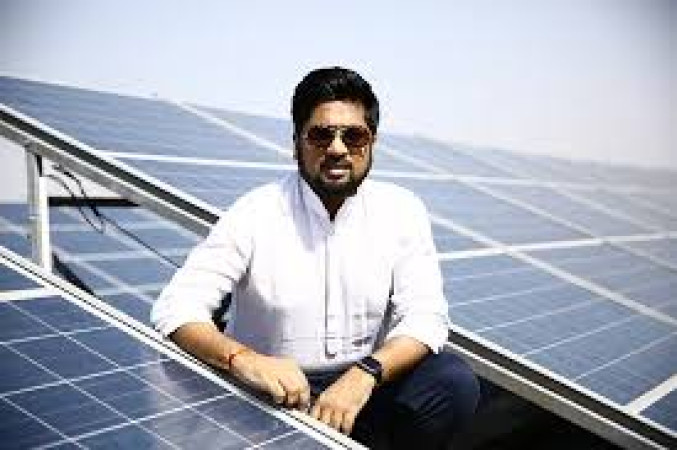
Despite concerns over slowing tender activity, tariff pressures in overseas markets, and rising domestic capacity, Gyanesh Chaudhary, Chairman and Managing Director of Vikram Solar, believes India’s renewable energy industry is entering a phase of scale, consolidation, and technological differentiation rather than decline.
Speaking to S Dinakar, Chaudhary argues that fears of an impending downturn in the solar manufacturing business are overstated, pointing to strong long-term demand, expanding capacity at Vikram Solar, and the growing role of storage solutions in stabilising the grid.
Post-IPO Growth Strategy
Chaudhary says the momentum seen in the past year has been unlike anything in the company’s two-decade history. With India expected to add 40–50 GW of renewable capacity in 2025, Vikram Solar is expanding in step with the market.
The company began the year with 4.5 GW of module manufacturing capacity and is set to close the year with over 9.5 GW. An additional 6 GW is planned in the near term. Alongside module expansion, Vikram Solar is investing in upstream cell manufacturing and battery energy storage, signalling a deeper push into the renewable value chain in line with government policy and an emerging consolidation trend in the sector.
On Falling Share Prices
Addressing the recent decline in solar stock prices, Chaudhary says the debate around overcapacity fails to account for technological differences. According to him, there is still a shortage of high-efficiency, advanced products.
Market recovery, he adds, will depend on how effectively companies can differentiate themselves. Manufacturers capable of delivering cutting-edge technology and higher efficiency will continue to perform well, while others may struggle.
Major Manufacturing Investments
Vikram Solar is making large-scale investments to support its growth ambitions. At its Gangaikondan facility in Tamil Nadu’s Tirunelveli district, the company is investing Rs 26,200 crore to set up integrated cell and module manufacturing with a capacity of 12 GW, scheduled for commissioning by FY27.
Separately, the company is investing Rs 1,800 crore over two years to expand module manufacturing capacity by 11 GW. By the end of the current year, total capacity is expected to reach 15.5 GW. A 5 GW facility at Vallam near Chennai has already been commissioned, while another 6 GW is under construction and expected to be ready by FY26.
Tendering Slowdown and Grid Constraints
Chaudhary dismisses concerns over a slowdown in renewable tenders, calling them short-term and misleading. With India growing at around 8 per cent annually, electricity demand is rising rapidly, adding 5–7 per cent new demand to the grid each year.
He points out that the real constraints lie in grid infrastructure, the financial health of discoms, and the integration of storage. Citing China’s deployment of over 200 GW of grid-scale storage, he stresses that battery storage can help shift peak demand to non-solar hours, improving grid stability as renewable penetration rises.
US Market and Global Strategy
While the US remains the largest export market for Indian solar manufacturers, Chaudhary notes that high tariffs and unfavourable cost structures limit competitiveness there. Over the next three years, he expects Indian manufacturers to gain ground globally, as US manufacturing costs and challenges in building upstream supply chains reduce efficiency.
Vikram Solar is evaluating the possibility of setting up operations in the US, though cost considerations remain a key factor.
Backward Integration, Storage, and Hydrogen
Further backward integration, including wafer manufacturing, is under discussion and may be announced next year. On emerging technologies, Chaudhary says green hydrogen remains a longer-term opportunity, with the company currently benchmarking technologies and partnering for future plans.
Battery storage, however, is already underway. Vikram Solar has launched its first phase of battery assembly and cell manufacturing, targeting 75 GW of cell manufacturing capacity. Its long-term goal is to deploy 30 GW of integrated battery energy storage across India.
Capacity Utilisation and Competition
The company’s manufacturing utilisation currently stands at around 65 per cent, well above the industry average of 45–55 per cent. Chaudhary maintains that scale, integration, and global-quality products will determine winners in the solar manufacturing space.
On competition with China, he observes that India’s domestic ecosystem is strengthening, while the advantages Chinese manufacturers once enjoyed through heavy subsidies and incentives are steadily diminishing.
Related News

Bihar Unveils Rs 1.40 Lakh Crore Energy Investment…
The Government of Bihar has presented an ambitious roadmap for transforming the…

GK Energy Revenue Jumps 71% in Q1 FY27 as Renewable…
GK Energy, a decentralised renewable energy infrastructure company focused on solar…
Siemens Energy India Q3 FY26 Revenue Surges 39.3%…
Siemens Energy India Ltd. delivered a strong financial performance in the third…