Follow India Renewable Energy News on WhatsApp for exclusive updates on clean energy news and insights
U-Solar Named L1 Bidder for NSPCL’s 20 MW Floating Solar Project in Chhattisgarh
Aug 09, 2026
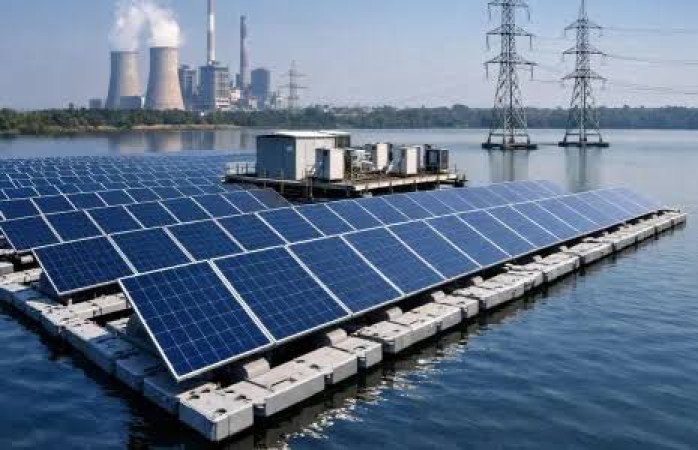
U-Solar Clean Energy Solutions Pvt. Ltd. has emerged as the lowest bidder (L1) for a 20 MW floating solar photovoltaic project planned at Maroda Reservoir 2 in Bhilai, Durg district of Chhattisgarh. The project is being developed by NTPC SAIL Power Company Ltd. (NSPCL), a joint venture between NTPC Ltd. and Steel Authority of India Ltd. (SAIL), and is expected to be commissioned within one year of the award of the contract.
U-Solar submitted a financial bid of Rs 127.47 crore for the project. However, the final bidder ranking was not determined solely by the quoted project cost. NSPCL evaluated the bids based on the cost in relation to estimated annual electricity generation. U-Solar achieved the L1 position with an evaluated rate of Rs 2.90 crore per million units (MU) of estimated annual generation, with the project expected to generate around 43.90 million units of electricity annually.
InSolare Energy Ltd. was ranked L2 after submitting a financial bid of Rs 134.88 crore and an evaluated rate of Rs 2.96 crore per MU, based on estimated annual generation of 45.54 million units. SLNKO Energy Pvt. Ltd. secured the L3 position with a bid of Rs 138.30 crore and an evaluated rate of Rs 3.12 crore per MU. Oriana Power, Floatex Solar and BVG India Ltd. occupied the subsequent positions in the bidding process.
The project will be executed under a single-stage, two-envelope domestic competitive bidding process. U-Solar, subject to the final award and contractual formalities, will be responsible for the engineering, design, procurement, installation, testing and commissioning of the floating solar plant. The project is also expected to include a complete balance-of-system package covering floating structures, anchoring and mooring arrangements, photovoltaic modules, inverters, civil works, electrical and mechanical systems and power evacuation infrastructure.
A 33 kV underground power evacuation system will form part of the project, along with a Supervisory Control and Data Acquisition (SCADA)-based central monitoring system. After commissioning, the selected contractor will also undertake operation and maintenance activities for three years. The combination of generation infrastructure, monitoring systems and dedicated evacuation facilities is intended to ensure reliable operation of the floating PV installation over its operating period.
Floating solar projects are gaining greater attention in India as developers look for ways to expand renewable generation without competing directly with agricultural or other land uses. By installing PV modules on suitable reservoirs and water bodies, such projects can utilise otherwise underused surface areas while potentially reducing evaporation from the covered portion of the water body. The absence of large-scale land acquisition can also be an advantage in locations where suitable land for utility-scale solar projects is limited.
The technology is particularly relevant for industrial and power-sector locations where existing reservoirs, cooling-water ponds or other water bodies are available near electricity infrastructure. Floating PV installations can also benefit from the cooling effect of the water environment, which may help solar modules maintain operating temperatures and support energy performance, although actual gains depend on site conditions, system design and weather patterns.
The Maroda Reservoir 2 project is significant in this context because it combines renewable power generation with an existing industrial and power-sector ecosystem in Bhilai. Chhattisgarh has a substantial industrial base, particularly in steel and other energy-intensive industries, making additional renewable electricity generation relevant to efforts to reduce the emissions intensity of power consumption.
The development also reflects the broader expansion of renewable energy procurement by large public-sector and industrial entities. As electricity demand rises and companies seek to reduce their dependence on conventional generation, solar power is increasingly being integrated into long-term energy strategies. Floating solar can complement conventional ground-mounted projects where land availability, water resources and grid connectivity make the technology commercially suitable.
With a planned capacity of 20 MW and estimated annual generation of nearly 43.90 million units, the NSPCL project will add another floating solar installation to India's growing portfolio of water-based renewable energy assets. The one-year implementation schedule will place emphasis on timely engineering, supply-chain coordination, floating-platform installation, anchoring, electrical works and grid integration. Once commissioned, the project is expected to contribute renewable electricity while demonstrating how industrial reservoirs can be utilised as platforms for clean-energy generation.
Related News

SECI Invites Bids for Renewable Power Trading Partner…
The Solar Energy Corporation of India (SECI) has invited bids to select a Power…
SECI Invites Bids for PMU System at 100 MW Solar and…
The Solar Energy Corporation of India (SECI) has invited bids for the supply, installation,…
U-Solar Named L1 Bidder for NSPCL’s 20 MW Floating…
U-Solar Clean Energy Solutions Pvt. Ltd. has emerged as the lowest bidder (L1) for…