Follow India Renewable Energy News on WhatsApp for exclusive updates on clean energy news and insights
$300 Billion AI Push Raises Questions Over Powering India’s Data Centre Expansion
Mar 06, 2026
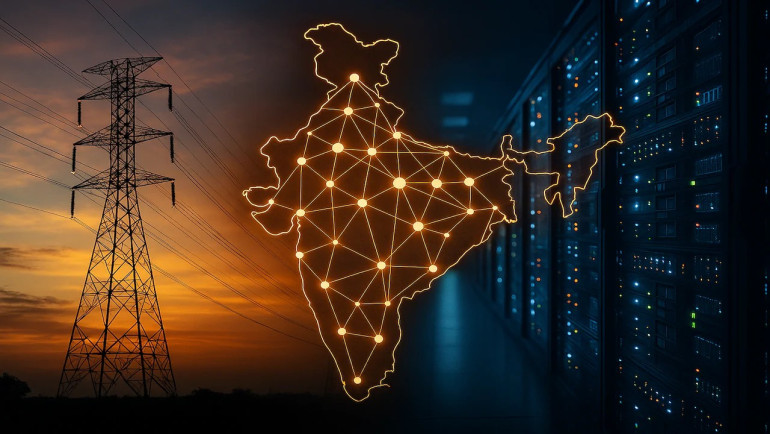
India’s ambition to become a global artificial intelligence hub, supported by nearly $300 billion in AI-related investment commitments, is triggering another critical race—one focused on securing sufficient electricity, water, and transmission infrastructure to support the rapid growth of data centres.
The country’s installed data centre capacity has already increased significantly, rising from around 520 MW in 2020 to about 1.5 GW by mid-2025. According to estimates from the Council on Energy, Environment and Water (CEEW), this capacity could expand to between 4.5 GW and 9 GW by 2030. Such growth would translate into an additional 3 GW to 7.5 GW of IT load within the next five years, placing pressure on regional power grids in major data centre clusters including Mumbai, Chennai, Hyderabad, the National Capital Region, and Bengaluru.
At present, data centres account for roughly 0.8–1 percent of India’s total electricity consumption, equivalent to about 18–22 terawatt-hours (TWh) annually. However, with hyperscale cloud growth, increased AI workloads, edge computing deployments, and higher utilisation rates, electricity demand from the sector is projected to reach 35–45 TWh by 2030. This could effectively double the sector’s power consumption within the decade.
Experts say the main challenge is not overall electricity availability but the ability of regional grids to supply reliable power to concentrated clusters of data centres. Prateek Aggarwal, programme lead at CEEW, noted that renewable energy combined with storage solutions could meet around 70–80 percent of annual demand. However, he added that sustainable scaling would require stronger transmission networks, flexible generation sources, and supportive market reforms.
Labanya Prakash Jena, director at the Climate and Sustainability Initiative (CSI), cautioned that the sector’s electricity demand could grow sharply. He said that while data centres currently consume less than one percent of India’s electricity, their share could rise significantly in the coming years. Since these facilities require uninterrupted 24/7 power supply, coal-based electricity is likely to remain part of the energy mix, as LNG-based generation remains relatively expensive in India.
The concentration of data centre development in major urban clusters further complicates the challenge, particularly in areas already experiencing resource constraints. Water consumption is emerging as a pressing concern. In 2025, India’s data centre industry used an estimated 150 billion litres of water annually, primarily for cooling systems. As capacity expands, this figure could more than double by 2030.
Jena highlighted that the issue may become increasingly serious in cities already facing water scarcity and high temperatures. He warned that policymakers could eventually face difficult decisions over allocating water resources between communities and large-scale data centre operations.
Research by CEEW also indicates gaps in water governance within state-level data centre policies. Of the 15 Indian states currently promoting data centre development, only five include specific sustainability provisions. Rajasthan’s 2025 policy stands out by requiring the use of treated wastewater, implementing zero liquid discharge standards, and promoting groundwater recharge measures.
Aggarwal suggested that India still has an opportunity to address these challenges through better policy frameworks. Technologies such as liquid immersion cooling and direct-to-chip cooling could significantly reduce water consumption, although adoption remains limited. He added that introducing water disclosure requirements and guidelines linking data centre locations to water basin availability could help manage future risks.
Transmission infrastructure presents another potential bottleneck. As renewable energy capacity continues to grow, insufficient grid expansion could delay project execution. Jena noted that investment in transmission networks needs to accelerate, particularly as large volumes of renewable power are integrated into the system.
Industry players are already preparing for the scale of demand expected in the coming years. Executives at the Adani Group said that their data centre projects are being designed with integrated energy strategies combining renewable power, storage systems, and grid reliability mechanisms. According to one senior executive, energy costs remain a critical factor for hyperscale data centres, and companies are optimising procurement strategies to ensure reliable 24/7 power while maintaining decarbonisation goals.
On the water management front, the company is exploring advanced cooling technologies such as treated wastewater use, closed-loop cooling systems, and zero liquid discharge wherever feasible. Another executive emphasised that efficiency metrics like power usage effectiveness (PUE) and water usage effectiveness (WUE) are central to the design of modern data centres, particularly as AI-driven workloads increase cooling demands.
India’s rapid expansion in AI and digital infrastructure is supported by favourable open-access renewable energy policies and competitive clean energy tariffs, making the country an attractive destination for global hyperscale operators. However, experts note that environmental governance and sustainability standards still vary across states.
As corporate net-zero commitments intersect with the rapid rise of AI infrastructure, the next phase of India’s data centre growth will depend not only on capital investment but also on how effectively the country can supply power, manage water resources, and upgrade transmission networks without triggering new resource pressures.
Related News
NIT Rourkela Develops AI-Powered Smart Monitoring…
Researchers at the National Institute of Technology (NIT) Rourkela have developed…
INVT Electric India Unveils Advanced Industrial Automation…
INVT Electric India showcased its latest portfolio of industrial automation and…
Andhra Pradesh's Proposed ‘Deemed Distribution Licensee’…
The Andhra Pradesh Government's proposal to grant "deemed distribution licensee"…