Follow India Renewable Energy News on WhatsApp for exclusive updates on clean energy news and insights
Agri-Photovoltaics in India: A Dual Path to Clean Energy and Agricultural Resilience
Apr 14, 2025
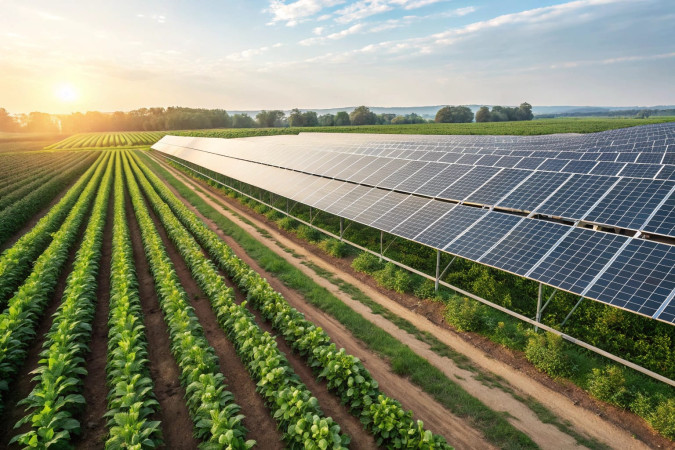
Agri-Photovoltaics (AgriPV)—the integration of solar power generation with agriculture—offers India a powerful opportunity to address both energy and food security. A recent feasibility study led by Auroville Consulting, in collaboration with GIZ and the German Government, evaluates the potential of AgriPV systems for potato farming in Maharashtra and apple farming in Himachal Pradesh.
What is AgriPV?
AgriPV systems involve installing solar photovoltaic (PV) panels over arable land to generate electricity without displacing agricultural activity. With India’s vast farmlands and ambitious renewable energy targets, AgriPV presents a promising model to optimize land use and empower rural economies.
Key Findings from the Report
Environmental and Biodiversity Challenges
While AgriPV can boost land productivity, the study highlights a concerning regulatory gap: solar projects currently fall under the “white category” of the Ministry of Environment, Forests, and Climate Change, meaning they are exempt from mandatory Environmental and Social Impact Assessments (ESIA). This can pose risks to biodiversity, especially in ecologically sensitive areas.
Moreover, shade from PV panels may reduce crop yields—a particular concern for potato cultivation in Maharashtra. The report suggests prioritizing shade-tolerant crops and urges research on optimizing AgriPV layouts for minimal agricultural disruption.
Business Model Viability
The study analyzes four models:
- Farmer-Owned
- Developer-Owned
- Joint Venture
- Behind-the-Meter (BtM)
The BtM model, aimed at high-consumption units like food processing facilities, emerged as the most feasible option under current conditions. However, smallholder farmers face barriers such as fragmented landholdings and grid connection restrictions (many states require a minimum 500 kW capacity for interconnection).
To ensure inclusivity, policy reforms enabling small-scale connections and support for Farmer Producer Organizations (FPOs) are essential.
Economic Barriers
Low solar feed-in tariffs and high upfront costs deter adoption. Without higher tariffs or alternative income streams, achieving a competitive return on investment (ROI) is difficult. The study proposes solutions like:
- Distributed Renewable Energy Credits (D-RECs)
- Carbon credits
- Locational feed-in tariffs
- Low-interest loans and project-based financing
Multidimensional Expert Assessment
A nationwide expert poll revealed mixed sentiments. Technological and policy uncertainty, limited power infrastructure, and unclear regulatory pathways were flagged as key barriers. However, experts expressed guarded optimism about ecological benefits—if AgriPV projects are well-planned and evidence-driven.
Socio-cultural acceptance remains limited due to low awareness, but targeted education and capacity-building could significantly improve uptake.
Strategic Recommendations
The report outlines several steps to scale AgriPV in India:
- Policy Reforms
- Mandate ESIAs for AgriPV systems.
- Develop zoning regulations for land use.
- Lower grid connection thresholds for small-scale AgriPV.
- Financial Support
- Revise feed-in tariffs to reflect AgriPV benefits.
- Introduce subsidies, D-RECs, and concessional loans.
- Farmer Education
- Launch awareness campaigns, especially targeting FPOs.
- Promote BtM model as a viable income diversification path.
- Research and Design Innovation
- Study crop compatibility with AgriPV setups.
- Develop modular system designs suited to regional farming needs.
AgriPV has the potential to transform India’s rural landscape by aligning the country’s renewable energy ambitions with agricultural livelihoods. However, its success hinges on regulatory clarity, financial innovation, and community engagement. With the right push, AgriPV could become a cornerstone of India's sustainable development strategy.
Related News
Rajasthan, Gujarat and Arunachal Pradesh Face Highest…
India's renewable energy expansion could face significant challenges from climate…
Solar Power Emerges as a Dominant Force in Meeting…
Solar energy, when paired with battery storage, is now capable of meeting up to…
ROQIT and Indian Railways Join Forces to Advance Sustainable…
ROQIT has entered into a strategic partnership with Indian Railways to roll out…