Follow India Renewable Energy News on WhatsApp for exclusive updates on clean energy news and insights
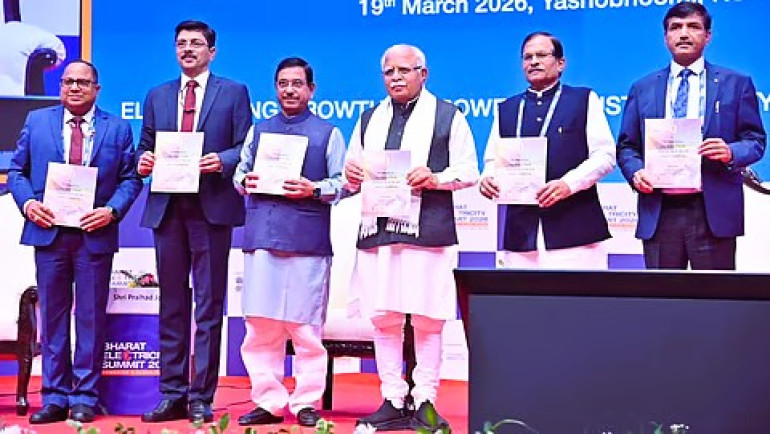
Bharat Electricity Summit 2026 Wraps Up with Global Participation and Clear Strategy for Power Sector Growth
Mar 23, 2026
The inaugural Bharat Electricity Summit 2026 concluded on a high note, bringing together policymakers, global experts, industry leaders, and investors to discuss the future of India’s electricity sector. The event served as a key forum to accelerate the clean energy transition, promote collaboration, and outline practical strategies for building a robust and sustainable power ecosystem.
The summit witnessed large-scale participation, attracting over 35,000 visitors, representatives from 28 states and Union Territories, more than 200 exhibiting companies—including over 80 startups—along with 6,000+ delegates, 300+ speakers, and 100+ conference sessions. The scale of engagement highlighted the growing global interest in India’s energy transformation journey.
Aligned with the vision of Narendra Modi, India continues to make rapid progress toward its target of achieving 500 GW of non-fossil fuel capacity by 2030, already surpassing 50% in non-fossil installed capacity. Initiatives such as “One Sun, One World, One Grid” further reinforce the country’s commitment to global energy cooperation.
In his closing remarks, Manohar Lal Khattar described the summit as highly successful, noting strong participation across all segments of the power sector. He emphasised the importance of innovation, particularly highlighting the role of startups in driving future advancements. He also reiterated India’s broader vision of becoming a developed nation by 2047, underlining electricity as a critical enabler for economic growth and universal access achieved through initiatives like Saubhagya.
He further stressed the need to strengthen power distribution companies (DISCOMs) through reforms, including the adoption of smart metering and cost-reflective tariffs. The discussions indicated a willingness among DISCOMs to improve operational efficiency and financial health.
Shripad Naik highlighted three major takeaways from the summit: the growing role of states in driving innovation, steady progress in distribution reforms, and the emergence of a more integrated energy transition that combines renewables, storage, transmission, and digital technologies.
Meanwhile, Pankaj Agarwal pointed out that industry interactions suggest a potential capital expenditure pipeline of around Rs 32,000 crore in the power sector. He stressed the importance of evaluating power costs at a system level to ensure affordability and called for rapid expansion of energy storage capacity to support renewable integration.
India’s power sector continues to expand at a remarkable pace, with installed capacity exceeding 520 GW and transmission networks extending beyond 5 lakh circuit kilometres. Renewable energy has seen significant growth, particularly solar, while electricity demand is expected to rise by over 30% by 2030, driven by sectors such as AI-powered data centres and electric mobility.
Discussions at the summit also indicated that India’s long-term energy transition could require investments exceeding USD 22 trillion by 2070, opening up vast opportunities across generation, transmission, storage, and digital infrastructure.
The next edition of the summit is scheduled to take place in Gandhinagar in 2028.
Related News
Bihar Unveils Rs 1.40 Lakh Crore Energy Investment…
The Government of Bihar has presented an ambitious roadmap for transforming the…
GK Energy Revenue Jumps 71% in Q1 FY27 as Renewable…
GK Energy, a decentralised renewable energy infrastructure company focused on solar…
Siemens Energy India Q3 FY26 Revenue Surges 39.3%…
Siemens Energy India Ltd. delivered a strong financial performance in the third…