Follow India Renewable Energy News on WhatsApp for exclusive updates on clean energy news and insights
Data Centre Racks Advancing Toward 1 MW Power Density Amid AI Surge, Says Vertiv CEO
Feb 25, 2026
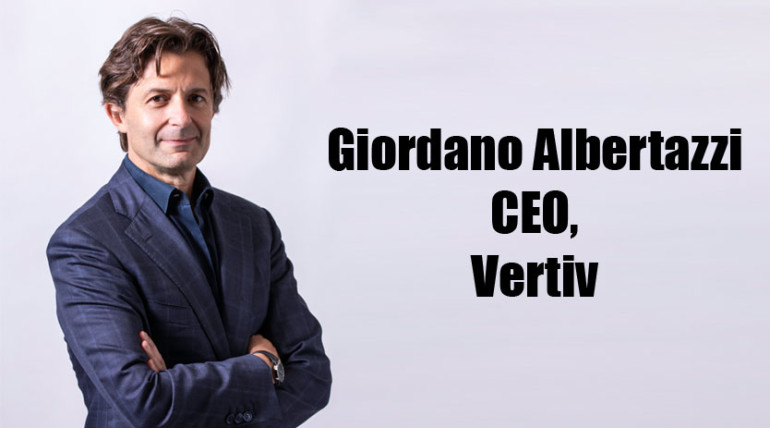
The rapid expansion of artificial intelligence (AI) workloads is accelerating a major shift in data centre design, with rack power densities moving closer to one megawatt (MW), according to Giordano Albertazzi, Chief Executive Officer of Vertiv.
Speaking on the sidelines of the India AI Impact Summit, Albertazzi noted that the industry has already progressed beyond 100 kilowatts (kW) per rack and is quickly approaching 600 kW levels. He added that achieving a full megawatt per rack is no longer a distant concept but an emerging near-term possibility.
Traditionally, data centre racks operated within a 15–30 kW range. However, the growth of high-performance computing (HPC), AI-driven applications, and expanding cloud infrastructure has significantly increased energy requirements over the past two years. This transformation is reshaping how facilities are designed, powered, and cooled.
Albertazzi highlighted that India has become Vertiv’s second-fastest growing market after the United States. The company manufactures the complete power train and thermal management portfolio at its facilities in Pune, serving both domestic and international markets. These systems include transformers, switchgear, uninterruptible power supplies (UPS), power distribution units, and busways—critical components that transfer large volumes of electricity from the grid to computing chips.
He also pointed to a broader technological transition underway. While most data centres currently operate on alternating current (AC) architectures, the evolution of advanced semiconductor technologies is expected to drive a gradual shift toward high-voltage direct current (HVDC) systems.
Another significant change involves cooling infrastructure. As higher-density racks generate substantially more heat, traditional air-cooling methods are increasingly being replaced by advanced liquid-cooling systems. Vertiv, which positions itself as a global leader in liquid cooling technology, sees strong growth potential in this segment.
Albertazzi emphasized that India’s AI-driven growth is prompting the construction of new, purpose-built facilities rather than retrofitting older, cloud-saturated data centres. The surge in AI adoption, he noted, is redefining industry benchmarks for power density, thermal management, and overall infrastructure design.
Related News
NIT Rourkela Develops AI-Powered Smart Monitoring…
Researchers at the National Institute of Technology (NIT) Rourkela have developed…
INVT Electric India Unveils Advanced Industrial Automation…
INVT Electric India showcased its latest portfolio of industrial automation and…
Andhra Pradesh's Proposed ‘Deemed Distribution Licensee’…
The Andhra Pradesh Government's proposal to grant "deemed distribution licensee"…