Follow India Renewable Energy News on WhatsApp for exclusive updates on clean energy news and insights
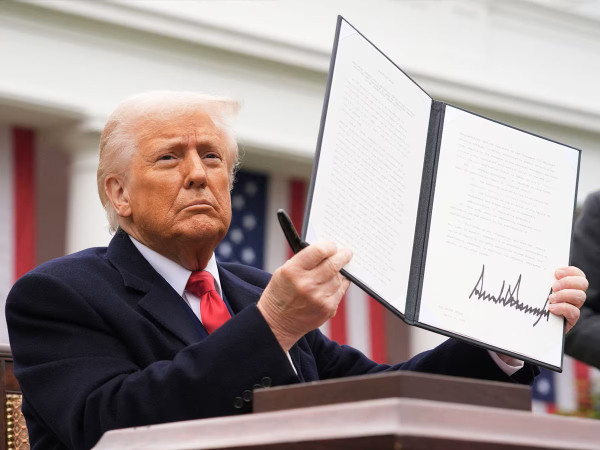
Donald Trump Could Invoke Alternative Trade Laws to Reinstate Tariffs After Supreme Court of the United States Ruling
Feb 24, 2026
Short-term relief likely for Indian and Chinese solar exporters, but policy uncertainty persists. The U.S. Supreme Court’s decision to invalidate former President Donald Trump’s broad-based trade tariffs has, at first glance, been viewed as a positive development for the clean energy sector. However, the broader trade landscape remains uncertain, as the White House retains the authority to impose import duties under alternative legal provisions.
The United States continues to depend heavily on imports for key renewable energy components, including solar cells and modules, even as domestic manufacturing capacity expands. In the immediate aftermath of the Court’s ruling striking down the country-specific reciprocal tariffs introduced under the International Emergency Economic Powers Act (IEEPA), market participants expect potential price easing not only for solar panels but also for battery cells and packs, power transformers, and inverters.
For solar-exporting nations such as India and China, the ruling could provide temporary relief. Nevertheless, uncertainty remains as the administration considers other mechanisms to reintroduce trade barriers.
Within hours of the Supreme Court verdict, a 10% blanket tariff on all imports was announced, later increased to 15% under a seldom-invoked trade statute. While this tariff will remain in effect for 150 days, any extension beyond that period would require Congressional approval.
Another potential pathway lies within provisions of the Trade Expansion Act, which empowers the President to impose tariffs on imports deemed to threaten national security—a term that can be interpreted broadly. Unlike IEEPA-linked measures, tariffs imposed under this framework can target specific products and are not subject to explicit rate caps.
Additionally, Section 301 of the Trade Act authorizes the United States Trade Representative (USTR), at the direction of the President, to investigate alleged unfair trade practices affecting U.S. commerce. Measures under this section can be country-specific and product-focused. In December 2024, for instance, the USTR levied 50% tariffs on Chinese solar wafers and polysilicon and 25% duties on certain tungsten products under Section 301.
For now, U.S. Customs and Border Protection has confirmed it will cease collecting tariffs imposed under IEEPA from February 24.
The ruling introduces both risks and opportunities for countries that had recently negotiated interim trade understandings with the United States. India, which had announced a preliminary agreement earlier this month and was scheduled to finalize terms this week, has seen those discussions postponed without a new date confirmed.
This delay could allow India to revisit and potentially renegotiate aspects of the arrangement. Meanwhile, U.S. officials have indicated that partner countries are expected to honor previously agreed terms. Trump has also stated that existing understandings with China remain unchanged despite the Court’s ruling, reiterating that tariffs on trading partners would continue.
Indian solar exporters, who had earlier welcomed a reduction in tariffs from 25% to 18%, may see further short-term gains from the Court’s intervention. However, the evolving policy environment continues to cast a shadow over long-term trade clarity.
Related News

Bihar Unveils Rs 1.40 Lakh Crore Energy Investment…
The Government of Bihar has presented an ambitious roadmap for transforming the…
GK Energy Revenue Jumps 71% in Q1 FY27 as Renewable…
GK Energy, a decentralised renewable energy infrastructure company focused on solar…
Siemens Energy India Q3 FY26 Revenue Surges 39.3%…
Siemens Energy India Ltd. delivered a strong financial performance in the third…