Follow India Renewable Energy News on WhatsApp for exclusive updates on clean energy news and insights
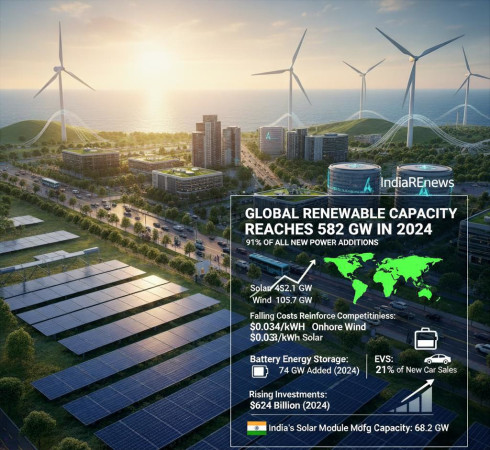
Global Renewable Capacity Reaches 582 GW in 2024, Accounting for 91% of All New Power Additions
Oct 23, 2025
Global Renewable Energy Capacity Surges in 2024, Led by Solar and Wind
Global renewable energy capacity expanded significantly in 2024, with 581.9 GW of new installations representing 91 percent of all power additions worldwide, according to the International Renewable Energy Agency (IRENA). This marks a 15.1 percent year-on-year increase and a 0.7 percent rise over 2023. However, growth remains insufficient to meet the 2030 target of 11.2 TW of global renewable capacity, requiring an average of 1,122 GW to be added annually between 2025 and 2030.
Solar and Wind Lead Expansion
Solar power dominated new installations, contributing 452.1 GW of capacity, followed by onshore wind with 105.7 GW. Offshore wind growth slowed to 8.6 GW compared to 11.6 GW in 2023. At the current pace, total renewable capacity is projected to reach 10.3 TW by 2030, 7.7 percent short of the target. Accelerated deployment of roughly 16.6 percent annually will be needed to bridge the gap.
Uneven Regional Growth
Asia, Europe, and North America accounted for 85.4 percent of global installed capacity by the end of 2024. Asia led with 71 percent of new capacity additions, while Europe added 71.9 GW, a 9.2 percent increase, reaching 19.1 percent of global capacity.
Falling Costs Reinforce Competitiveness
Renewables remain the most cost-effective new electricity source, with 91 percent of utility-scale projects delivering cheaper power than the lowest-cost fossil fuel alternative. Global weighted average LCOE was $0.034/kWh for onshore wind, $0.043/kWh for solar, and $0.054/kWh for hydropower. Installed costs fell to $691/kW for solar, $1,041/kW for onshore wind, and $2,852/kW for offshore wind. Battery storage costs dropped nearly 30 percent year-on-year, a 93 percent decline since 2010.
Growth in Energy Storage and Electric Vehicles
Battery storage capacity increased by 74 GW (around 180 GWh) globally in 2024, nearly double the previous year. China, the U.S., and Europe contributed 85 percent of this growth. Hydrogen electrolyzer capacity surpassed 6 GW, and electric vehicles accounted for 21 percent of all new car sales, with passenger EVs at 26 percent market share and two- and three-wheelers at 45 percent. Global EV stock must rise from 57 million in 2024 to 360 million by 2030 to meet energy transition goals.
Rising Investments in Renewables
Global investment in renewable power reached $624 billion in 2024, up 7 percent from 2023. Solar captured $436 billion of this total. Achieving the 2030 target will require an additional $8.6 trillion investment between 2025 and 2030, with cumulative spending on renewables, grids, flexibility measures, and energy efficiency reaching $29–30 trillion. Annual investment in renewable generation alone must increase 2.3 times to $1.44 trillion, up from $600 billion in 2024. Battery manufacturing investments nearly doubled to $74 billion, grid infrastructure spending grew by 9 percent, and battery storage investments rose 33 percent to $54 billion.
India’s Expanding Role
India’s solar module manufacturing capacity grew to 68.2 GW in 2024, up from 49.3 GW in 2023. U.S. tariffs on Southeast Asian products redirected exports to India. India added 3.4 GW of wind capacity in 2024, accounting for 0.8 percent of global additions, and received 1 percent of global renewable manufacturing investments, projected to rise to nearly 8 percent by 2025–2026.
Policy and Action Required
IRENA emphasizes that countries must strengthen supply chains, create clear regulatory frameworks, and define measurable renewable energy targets in their Nationally Determined Contributions (NDCs). Developing comprehensive investment strategies to support bankable mitigation projects, combined with consistent policy support and international cooperation, will be critical to achieving a sustainable energy future.
Related News

Tamil Nadu Unveils Rs 1 Lakh Rooftop Solar Subsidy…
The Tamil Nadu Government has announced a new rooftop solar subsidy of up to Rs…

MERC Clears MSEDCL’s 2,269 MW Distributed Solar Procurement…
The Maharashtra Electricity Regulatory Commission (MERC) has approved the tariffs…

OERC Proposes New 10 MW Distributed Renewable Energy…
The Odisha Electricity Regulatory Commission (OERC) has proposed a new regulatory…