Follow India Renewable Energy News on WhatsApp for exclusive updates on clean energy news and insights
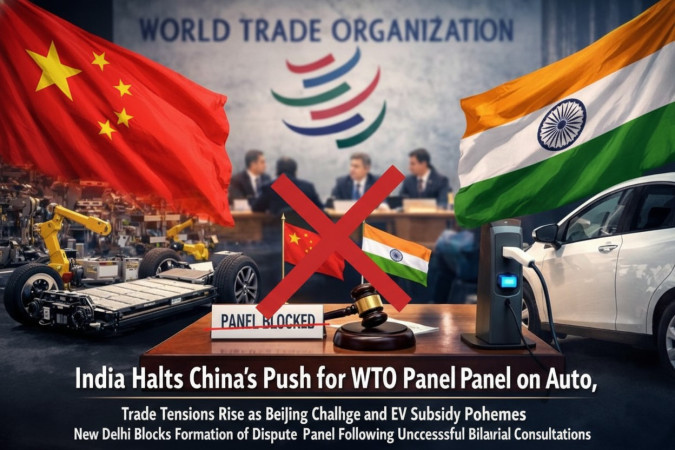
India Halts China’s Push for WTO Panel on Auto, Battery and EV Subsidy Policies
Jan 29, 2026
India has formally blocked China’s request to establish a dispute panel at the World Trade Organization (WTO) over New Delhi’s incentive programmes for automobiles, battery manufacturing, and electric vehicles, following unsuccessful bilateral consultations between the two countries.
According to a Geneva-based trade official, China approached the WTO after talks held on November 25, 2025, and January 6, 2026, failed to address its concerns. Beijing claims that certain eligibility conditions under India’s Production Linked Incentive (PLI) schemes and EV manufacturing policies discriminate against Chinese-origin products and breach multilateral trade commitments.
In a submission to the WTO dated January 16, China stated that it had attempted to reach a mutually acceptable solution through consultations, but the discussions did not yield results. As a result, China requested the WTO’s Dispute Settlement Body (DSB) to constitute a panel to examine the matter and sought inclusion of the request on the agenda of the DSB meeting held on January 27 in Geneva.
The dispute centers on three Indian initiatives: the PLI scheme for the Automobile and Auto Components sector, the National Programme on Advanced Chemistry Cell (ACC) Battery Storage, and the Scheme to Promote Manufacturing of Electric Passenger Cars in India. China argues that these programmes link incentives to the use of domestically manufactured inputs, placing imported goods at a disadvantage.
Beijing contends that the measures are inconsistent with India’s obligations under several WTO agreements, including the Agreement on Subsidies and Countervailing Measures (SCM), the General Agreement on Tariffs and Trade (GATT) 1994, and the Trade-Related Investment Measures (TRIMs) Agreement. According to China, the policies adversely affect its exports in the automobile, battery, and electric vehicle segments.
Under WTO procedures, consultations represent the initial phase of dispute resolution. If they fail, the complainant may seek the formation of a panel to adjudicate the issue. India’s decision to block the request delays the start of formal panel proceedings at the multilateral trade body.
Both India and China are WTO members, and China remains India’s second-largest trading partner. The latest disagreement adds to a growing series of trade disputes between the two nations, particularly over industrial support mechanisms and market access conditions.
Related News
International Solar Alliance Seeks Consultants to…
The International Solar Alliance (ISA) has invited bids from eligible consulting…
Hinduja Renewables Crosses 4 TWh Green Power Generation…
Hinduja Renewables Energy Private Limited (HREPL), the renewable energy arm of the…
Mahavitaran CMD Lokesh Chandra Honoured for Driving…
Lokesh Chandra, Chairman and Managing Director of Maharashtra State Electricity…