Follow India Renewable Energy News on WhatsApp for exclusive updates on clean energy news and insights
India’s Energy Sector Presents $500 Billion Investment Potential, Says Prime Minister
Jan 29, 2026
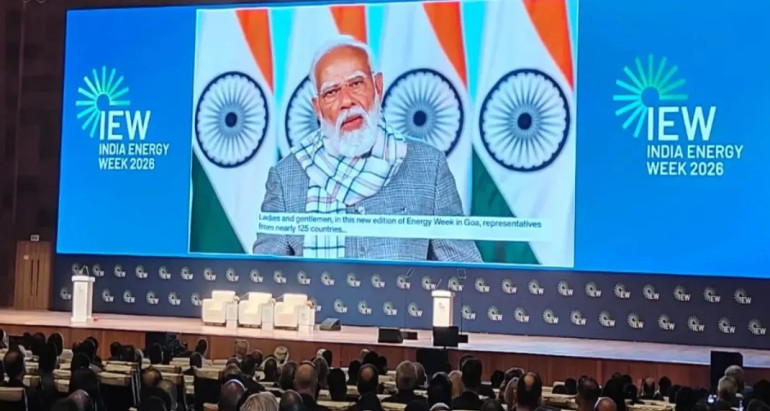
Prime Minister Narendra Modi on Tuesday invited global energy companies to invest across India’s energy value chain, stating that the country’s energy sector offers investment opportunities worth $500 billion as India advances toward energy independence.
Addressing the inaugural session of India Energy Week 2026, the Prime Minister said India has strengthened its energy security in recent years and is now steadily moving towards self-reliance in the sector.
“The energy sector stands at the core of our national aspirations. It offers opportunities of nearly $500 billion. I urge global players to manufacture in India, innovate in India, scale with India, and invest in India,” Modi said.
He added that the government is targeting $100 billion in investments in oil and gas exploration by 2030, with a strong focus on expanding domestic production and reducing import dependence.
India currently imports nearly 90% of its crude oil requirements, making it the world’s third-largest oil importer. Ongoing geopolitical uncertainties—including developments in West Asia, US interventions in Venezuela, and sanctions on major Russian oil suppliers—have pushed Indian refiners to diversify their crude sourcing strategies.
Highlighting reforms in the upstream sector, the Prime Minister said India is developing a robust energy ecosystem capable of meeting domestic demand and supporting competitive exports through affordable refining and transportation solutions.
He underlined efforts to boost domestic hydrocarbon output, pointing to policy measures such as the Hydrocarbon Exploration and Licensing Policy (HELP) and initiatives to open up previously restricted exploration areas. The Samudra Manthan Mission, aimed at enhancing deep-sea exploration, was cited as a key step in this direction.
Modi said the Andaman and Nicobar Basin is emerging as a major hydrocarbon frontier. Under HELP, the government has allocated four exploration blocks covering about 23,261 sq km in the basin, with another four blocks spanning nearly 17,035 sq km also being offered.
According to the India Hydrocarbon Resource Assessment Study (IHRAS), the Andaman-Nicobar Basin holds estimated hydrocarbon resources of 371 million metric tonnes of oil equivalent (MMTOE). In September 2025, state-run Oil India Ltd reported the occurrence of natural gas in an offshore block awarded under the Open Acreage Licensing Policy (OALP).
The Prime Minister said continued reforms—such as reducing no-go areas—are improving project viability and profitability for companies investing in exploration.
On natural gas, Modi noted that LNG demand in India is rising, with a target to meet 15% of total energy demand through LNG. He stressed the importance of developing the entire LNG value chain, including transportation and infrastructure.
India is also working to build LNG carriers domestically, supported by a recently launched Rs 1.7 lakh crore shipbuilding programme, he said. Additional investment opportunities exist in port-based LNG terminals, regasification facilities, pipelines, city gas distribution networks, and petrochemicals, he added.
Noting that India is among the top five exporters of petroleum products, supplying over 150 countries, Modi said the government is working to expand the country’s refining capacity from 260 million tonnes to 300 million tonnes, reinforcing India’s position as a global energy hub.
Related News
Bihar Unveils Rs 1.40 Lakh Crore Energy Investment…
The Government of Bihar has presented an ambitious roadmap for transforming the…

GK Energy Revenue Jumps 71% in Q1 FY27 as Renewable…
GK Energy, a decentralised renewable energy infrastructure company focused on solar…
Siemens Energy India Q3 FY26 Revenue Surges 39.3%…
Siemens Energy India Ltd. delivered a strong financial performance in the third…