Follow India Renewable Energy News on WhatsApp for exclusive updates on clean energy news and insights
India’s Solar Boom Slows as Sector Enters Recalibration Phase
Dec 15, 2025
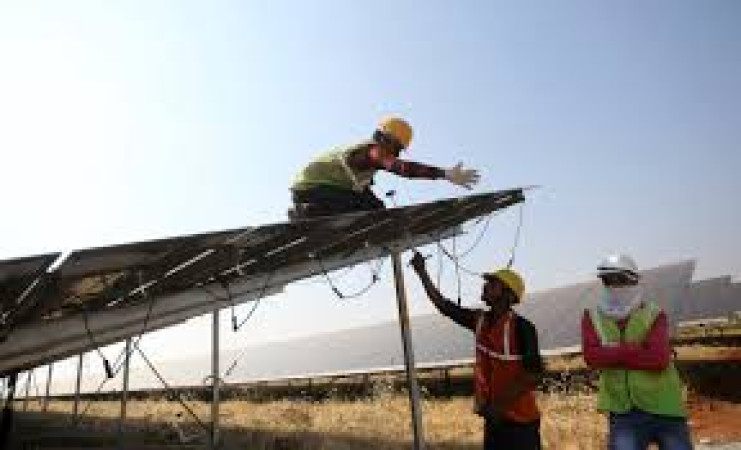
After years of rapid expansion, India’s solar power sector is witnessing a slowdown as grid constraints, muted electricity demand growth, stalled contracts, and rising storage requirements begin to reshape the industry’s trajectory.
While India had aimed to tender 50 GW of renewable capacity annually to reach 500 GW of non-fossil fuel capacity, actual additions have moderated to 15–25 GW per year. Despite this, overall renewable capacity has grown sharply—from 35 GW in 2014 to nearly 197 GW today.
According to the Ministry of New and Renewable Energy (MNRE), the sector has moved from a phase of capacity expansion to one focused on capacity absorption, with emphasis now on grid integration, energy storage, hybrid projects and market reforms. The ministry has described the slowdown as a necessary recalibration to ensure stable and dispatchable growth.
Data from Icra shows renewable energy capacity awarded rose from 9.3 GW in FY23 to 47.3 GW in FY24, before easing to 40.6 GW in FY25 and falling sharply to 5.8 GW in the first eight months of FY26. Unsigned power purchase agreements remain high at 40–45 GW, reflecting procurement and connectivity challenges.
A key shift underway is the move toward firm and dispatchable renewable energy (FDRE) and round-the-clock (RTC) tenders, which combine renewable generation with mandatory energy storage. While this addresses intermittency, it increases project costs and adds pressure on tariffs.
Transmission infrastructure continues to lag generation growth. The government is addressing this through a Rs 2.4 trillion transmission expansion plan, aimed at linking renewable-rich states with demand centres and unlocking over 200 GW of future capacity.
Experts note that limited Time-of-Day pricing and slower demand growth have further complicated solar integration, increasing reliance on storage solutions. Meanwhile, stalled power sale agreements—nearly 43.9 GW as of September—remain a key concern, with distribution companies hesitant to commit amid connectivity delays.
Officials maintain that the current phase represents a temporary transition rather than a structural slowdown, and that strengthening grids, storage and market mechanisms will be critical to sustaining India’s clean energy ambitions and its 2070 net-zero target.
Related News

Bihar Unveils Rs 1.40 Lakh Crore Energy Investment…
The Government of Bihar has presented an ambitious roadmap for transforming the…

GK Energy Revenue Jumps 71% in Q1 FY27 as Renewable…
GK Energy, a decentralised renewable energy infrastructure company focused on solar…
Siemens Energy India Q3 FY26 Revenue Surges 39.3%…
Siemens Energy India Ltd. delivered a strong financial performance in the third…