Follow India Renewable Energy News on WhatsApp for exclusive updates on clean energy news and insights
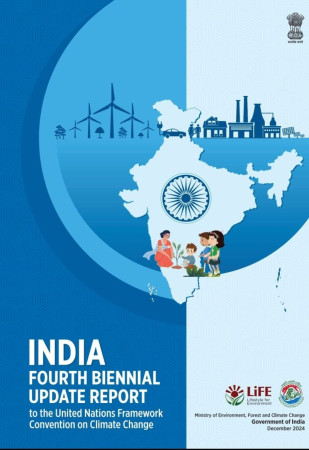
India submitted its Fourth Biennial Update Report (BUR-4) to United Nations Framework Convention on Climate Change (UNFCCC).
Jan 02, 2025
India kicks off the year with remarkable news on its climate action milestones, showcasing its leadership in global sustainability efforts.
- Emission Intensity Reduction: By 2022, India achieved a 36% reduction in emission intensity of its GDP, compared to 2005 levels.
- Clean Energy Growth: By late 2024, India increased its clean energy share to an impressive 46.52% of total installed capacity.
These accomplishments were highlighted in India’s Fourth Biennial Update Report (BUR-4), a vital document submitted to the United Nations Framework Convention on Climate Change (UNFCCC).
What is BUR-4, and Why is it Important?
Think of BUR-4 as India’s climate performance report card. It offers a comprehensive update on the nation’s progress in reducing emissions, adapting to climate challenges, and planning for a sustainable future. At its core, BUR-4 provides a detailed National Greenhouse Gas (GHG) Inventory, presenting data on emissions and removals from various sectors.
Key Highlights from India’s GHG Inventory:
- Energy Sector: The largest contributor, accounting for 75.66% of total emissions.
- Agriculture: Contributes 13.72%, driven by livestock farming and rice cultivation.
- Industrial Processes: Represent 8.06% of emissions.
- Waste Sector: Accounts for 2.56%.
- Forests as Carbon Sinks: In 2020, India’s forests removed 522 MtCO?e, showcasing their critical role in mitigating climate change.
India’s Mitigation and Adaptation Efforts:
- Solar Energy Expansion: Solar capacity has grown 35 times since 2014, accelerating the nation’s transition to renewable energy.
- Energy Efficiency: The Perform, Achieve, and Trade (PAT) scheme helped avoid 28.74 MtCO? emissions.
- Indian Railways: Increased electricity usage to 31.81 TWh (2023-24), cutting diesel consumption by 56.5%.
- Mangrove Restoration: Initiatives like MISHTI are restoring 25,000 hectares of mangroves, strengthening coastal ecosystems.
The Financial Challenge:
To meet its climate goals, India will need an estimated ?85.6 lakh crore by 2030, as per the Reserve Bank of India (RBI). While this figure is substantial, it is achievable with the right combination of policy innovation, technological advancements, and community-driven action.
India’s consistent progress in renewable energy adoption, emission reduction, and natural ecosystem restoration reflects its commitment to a sustainable future. These milestones set a powerful example for nations worldwide, proving that climate action is not just necessary but achievable.
Related News

Rajasthan, Gujarat and Arunachal Pradesh Face Highest…
India's renewable energy expansion could face significant challenges from climate…

Solar Power Emerges as a Dominant Force in Meeting…
Solar energy, when paired with battery storage, is now capable of meeting up to…

ROQIT and Indian Railways Join Forces to Advance Sustainable…
ROQIT has entered into a strategic partnership with Indian Railways to roll out…