Follow India Renewable Energy News on WhatsApp for exclusive updates on clean energy news and insights
Low-Cost Government Land Fuels Concerns Over Rajasthan’s Solar Push Turning Speculative
Dec 23, 2025
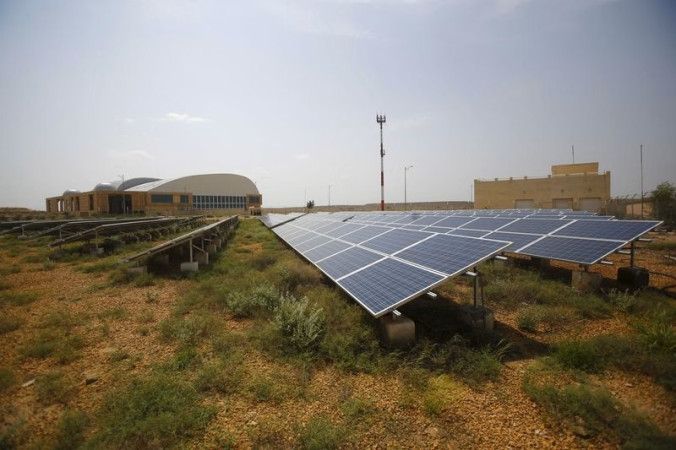
Jaipur: Even as communities across western Rajasthan await government action to protect nearly 8,000 acres of pasture and sacred oran land, the state’s rapid allocation of low-cost government land for solar projects has triggered concerns that renewable energy development is increasingly being driven by land economics rather than sustainable planning.
In September, conservationist Sumer Singh Bhati, along with thousands of farmers and livestock grazers, staged a mass protest in Jaisalmer demanding legal safeguards for common grazing lands and community-conserved groves. The agitation was paused in October after the state government assured protection, but more than two months later, no formal order has been issued.
Bhati said communities would wait another month before resuming protests if the government fails to act. He added that the uncertainty surrounding land protection has not slowed the state’s push to fast-track solar projects by allotting government land to private developers at relatively low rates.
According to Bhati, public land should primarily serve ecological and community needs rather than commercial interests alone. In arid regions such as western Rajasthan, he said, pasture and oran land play a critical role in sustaining livestock, biodiversity, and local livelihoods.
He further pointed out that the availability of cheaper government land has distorted land prices, leaving local landowners with little bargaining power. “When the government offers land at lower rates to companies, private landowners are unable to secure fair prices for their land,” Bhati said.
Industry observers argue that Rajasthan’s land-centric approach has transformed the solar sector into a real estate-driven activity, with limited downstream benefits. They say the current policy framework prioritises generation capacity while neglecting manufacturing, innovation, and long-term employment creation.
“The renewable energy policy is heavily tilted toward generation, which offers very few permanent jobs once projects are commissioned,” said D.D. Agarwal, Director of Samta Power, a power-sector NGO. He warned that without investment in manufacturing of solar cells, wafers, and ingots, Rajasthan risks remaining confined to a low-value role in the solar supply chain.
Despite leading the country in installed solar generation capacity, Rajasthan remains at the lowest end of the value chain. Experts note that once solar parks are operational, they generate limited ongoing economic activity for local communities.
A senior executive from a solar manufacturing company said the state has missed an opportunity to build a comprehensive solar ecosystem. “Rajasthan is well suited for large solar parks, but manufacturing requires a different policy mix—capital subsidies, shared testing infrastructure, and long-term certainty. States like Madhya Pradesh are pursuing the full value chain and are seeing results,” the executive said.
Stakeholders caution that unless policy direction shifts toward integrated solar manufacturing and value addition, Rajasthan may lock itself into a model where it primarily supplies land, while other states capture jobs, innovation, and higher tax revenues.
Related News
Bihar Unveils Rs 1.40 Lakh Crore Energy Investment…
The Government of Bihar has presented an ambitious roadmap for transforming the…

GK Energy Revenue Jumps 71% in Q1 FY27 as Renewable…
GK Energy, a decentralised renewable energy infrastructure company focused on solar…
Siemens Energy India Q3 FY26 Revenue Surges 39.3%…
Siemens Energy India Ltd. delivered a strong financial performance in the third…