Follow India Renewable Energy News on WhatsApp for exclusive updates on clean energy news and insights
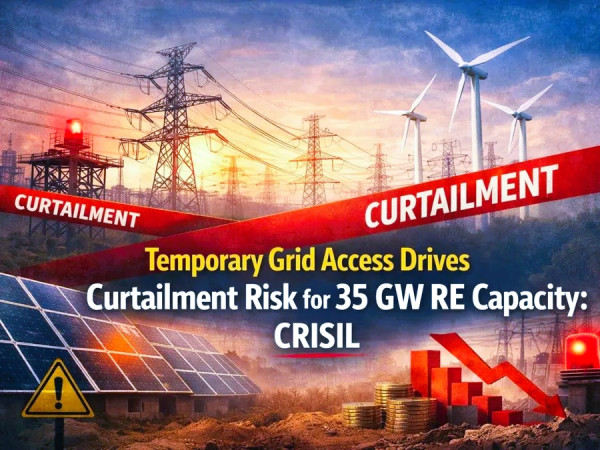
Over 35 GW Renewable Capacity May Face Curtailment Risk by FY27 Amid Grid Constraints: Crisil
Mar 20, 2026
More than 35 GW of renewable energy capacity in India could be exposed to grid curtailment risks by fiscal 2027, primarily due to slower expansion of transmission infrastructure compared to rapid capacity additions, according to Crisil Ratings.
The report highlights that limited availability of long-term grid connectivity is a key concern. Projects operating under temporary general network access (TGNA) are particularly vulnerable, as they lack dedicated transmission infrastructure and enjoy only short-term access to the grid. In contrast, projects with long-term general network access (LT GNA) benefit from stronger scheduling priority and more reliable evacuation systems.
With renewable capacity—especially solar—growing at a fast pace, the mismatch between generation and evacuation capabilities has intensified. This is particularly evident during daytime hours when surplus solar generation often exceeds grid handling capacity, leading to higher instances of curtailment. Between April and December 2025, projects under TGNA accounted for nearly 80% of total curtailment in the country.
The issue has been more pronounced in states like Rajasthan and Gujarat, which together contribute a significant share of India’s renewable energy output. In these regions, around 13–14 GW of TGNA-linked capacity experienced curtailment levels of up to 50%, driven by constraints in transmission infrastructure.
Crisil estimates that around 20 GW of new inter-state transmission system (ISTS)-connected renewable capacity could be commissioned under TGNA in FY27. Combined with existing TGNA capacity, this may push the total capacity at risk of curtailment to approximately 35–37 GW. However, many of these projects are expected to transition to long-term access as transmission networks expand over time.
Sustained curtailment can impact project financials, including debt servicing and returns. A 50% curtailment over a year could reduce debt service coverage ratios and equity returns, indicating rising financial complexity in the sector. Nevertheless, near-term risks may be cushioned by factors such as loan moratoriums, strong sponsor backing, and liquidity reserves.
To address these challenges, several measures are being explored. These include policy mechanisms like time-based grid access, allowing solar projects to utilise the grid during daylight hours while freeing capacity for other sources later. Additionally, increased deployment of battery energy storage systems is expected to help manage excess generation and improve overall grid efficiency in the long run.
Related News
Himachal Pradesh Commissions 500 kW Solar Plant in…
Himachal Pradesh has strengthened its clean energy and rural development initiatives…
SJVN Commissions India's Largest 1 GW Single-Site…
State-owned power producer SJVN Limited has commissioned a 1,000 MW (1 GW) Domestic…
JSW Breaks Ground on Green Steel Plant in Andhra Pradesh…
Andhra Pradesh has strengthened its position as an emerging hub for sustainable…