Follow India Renewable Energy News on WhatsApp for exclusive updates on clean energy news and insights
Union Cabinet Approves SHANTI Bill, Paving Way for Private Investment and 49 Percent FDI in Nuclear Power
Dec 15, 2025
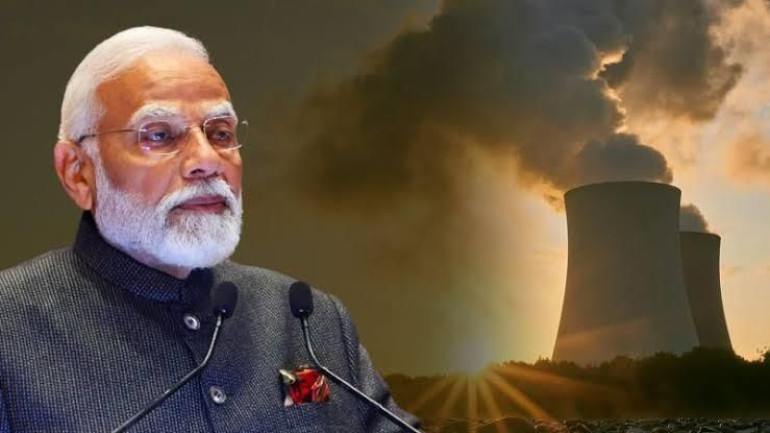
The Union Cabinet has cleared the Sustainable Harnessing and Advancement of Nuclear Energy for Transforming India (SHANTI) Bill, signalling a landmark policy reform that opens India’s highly regulated nuclear power sector to private participation.
The decision is considered a crucial step toward achieving India’s long-term goal of 100 GW of nuclear power capacity by 2047. A key feature of the proposed legislation is the overhaul of the country’s civil nuclear liability regime. The Bill seeks to provide greater protection to plant operators while limiting the liability exposure of equipment suppliers—an issue that has long deterred both domestic and international investors. It also proposes restructuring operator insurance coverage to Rs 1,500 crore per incident under the Indian Nuclear Insurance Pool.
Under the SHANTI framework, foreign direct investment of up to 49 percent will be permitted in nuclear power projects. The Bill further aims to create a single, consolidated legal framework governing atomic energy activities and proposes the establishment of a dedicated nuclear tribunal for dispute resolution.
Despite allowing private sector entry, the government will maintain strict regulatory control. The Department of Atomic Energy (DAE) will continue to oversee sensitive and strategic functions, including nuclear material production, heavy water manufacturing, and radioactive waste management. Private operators will be allowed to participate only within clearly defined regulatory boundaries and under government supervision.
The government’s intent to liberalise the nuclear sector was first outlined by Finance Minister Nirmala Sitharaman in her February Budget speech, during which she also announced a Rs 20,000 crore Nuclear Energy Mission. The mission is focused on research and development of small modular reactors (SMRs), with plans to commission five indigenously developed SMRs by 2033.
Prime Minister Narendra Modi had also indicated recently that preparations were underway to enable private participation in nuclear power generation, which is currently restricted under the Atomic Energy Act. At present, nuclear power generation in India is exclusively operated by Nuclear Power Corporation of India Ltd. (NPCIL), a public sector undertaking under the DAE, which manages all 24 operational nuclear reactors in the country.
According to government officials, the SHANTI Bill addresses long-standing constraints across the nuclear energy value chain. Rising electricity demand, rapid growth in data centres, and India’s commitment to achieving net-zero emissions by 2070 have been identified as major drivers behind the renewed emphasis on nuclear energy. Officials have noted that expanding nuclear capacity nearly tenfold over the next two decades would not be feasible without private-sector involvement.
Related News

Transformers & Rectifiers India Posts Higher Q1 FY27…
Transformers & Rectifiers India Limited (TARIL) has reported steady financial performance…

Eleven Power Plans INR 4,700 Crore Investment to Build…
Eleven Power, part of the diversified Eleven Group chaired by Medanta co-founder…

RIR Power Electronics to Commence NSE Trading, Strengthening…
RIR Power Electronics, an Indian manufacturer of high-power semiconductor devices…