Follow India Renewable Energy News on WhatsApp for exclusive updates on clean energy news and insights
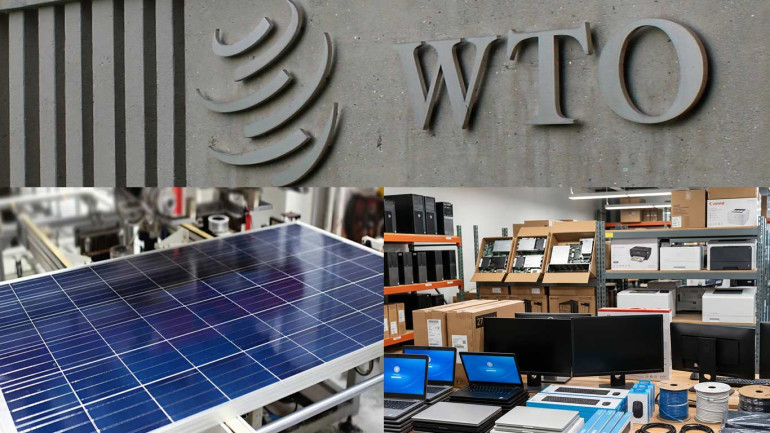
WTO Sets Up Dispute Panel to Examine China's Challenge Against India's Solar Incentives and Technology Tariffs
Jun 29, 2026
Geneva: The World Trade Organization (WTO) has agreed to establish a dispute settlement panel to review China's complaint against India's tariffs on certain technology products and incentive schemes for the domestic solar manufacturing sector, marking the next stage in a trade dispute between the two Asian economies.
The decision follows China's second request for the formation of a dispute panel. Under WTO dispute settlement procedures, while a member country can block the first request, a second request must be accepted automatically by the Dispute Settlement Body (DSB). The panel was approved after bilateral consultations between the two countries failed to produce a mutually agreed resolution.
China argues that India's import duties on selected information technology (IT) products and policy measures supporting domestic solar manufacturing are inconsistent with the country's obligations under WTO agreements. According to Beijing, certain incentive programmes provide preferential treatment to locally manufactured products and components, placing imported goods at a competitive disadvantage and affecting international trade.
India had exercised its right to block China's initial request for a dispute panel in May 2026, allowing additional time for consultations. However, with no settlement reached, the WTO has now initiated the formal adjudication process.
The dispute panel will examine whether India's measures comply with key WTO agreements, including the General Agreement on Tariffs and Trade (GATT), the Agreement on Subsidies and Countervailing Measures (SCM Agreement) and the Agreement on Trade-Related Investment Measures (TRIMs). After reviewing written submissions and conducting hearings, the panel will issue its findings, which can subsequently be appealed under the WTO's dispute settlement framework, subject to the applicable procedures.
The case comes at a time when governments worldwide are increasingly adopting industrial policies to strengthen domestic manufacturing in strategic sectors such as renewable energy, semiconductors and advanced technologies. India has introduced several production-linked incentive (PLI) schemes and other policy measures in recent years to reduce dependence on imports, encourage local manufacturing and build resilient clean energy supply chains.
For the solar sector, India has implemented initiatives including domestic manufacturing incentives, customs duties on imported solar equipment and the Approved List of Models and Manufacturers (ALMM) framework to promote indigenous production of solar modules and support the country's energy security objectives. China, meanwhile, remains the world's largest manufacturer and exporter of solar photovoltaic products and has raised concerns over measures that it believes restrict market access for Chinese companies.
The outcome of the WTO proceedings could have broader implications for international trade rules governing renewable energy manufacturing and industrial support policies. As countries continue investing heavily in domestic clean energy industries, the dispute is expected to be closely watched by policymakers and manufacturers, given its potential impact on future trade practices in the global renewable energy sector.
Related News

Bihar Unveils Rs 1.40 Lakh Crore Energy Investment…
The Government of Bihar has presented an ambitious roadmap for transforming the…

GK Energy Revenue Jumps 71% in Q1 FY27 as Renewable…
GK Energy, a decentralised renewable energy infrastructure company focused on solar…
Siemens Energy India Q3 FY26 Revenue Surges 39.3%…
Siemens Energy India Ltd. delivered a strong financial performance in the third…