Follow India Renewable Energy News on WhatsApp for exclusive updates on clean energy news and insights
CEEP, CSTEP, Indicc and Transitions Research Partner with Rajasthan Discoms to Boost Rooftop Solar Adoption
Nov 17, 2025
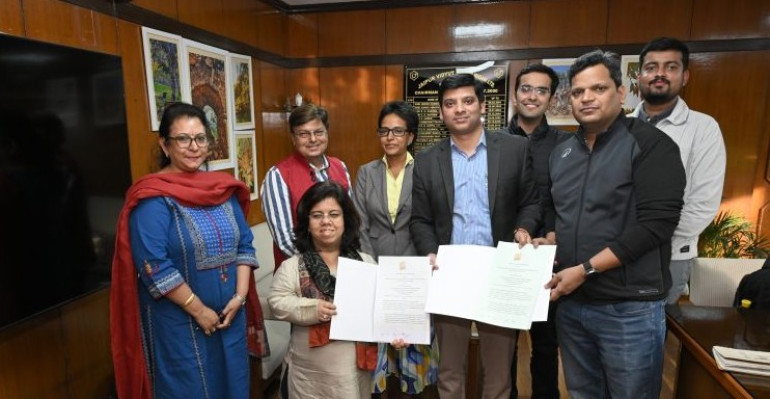
The Centre for Energy, Environment and People (CEEP), along with the Center for Study of Science, Technology and Policy (CSTEP), Indicc, and Transitions Research, has entered into a memorandum of understanding (MoU) with Rajasthan’s state-run power distribution companies to drive faster adoption of rooftop solar and enhance energy efficiency across the state.
The agreement has been signed with Jaipur Vidyut Vitran Nigam (JVVNL), Jodhpur Vidyut Vitran Nigam (JDVNL), and Ajmer Vidyut Vitran Nigam (AVVNL).
Through this partnership, the organisations will support the expansion of rooftop solar systems and help strengthen the implementation of major government schemes, including the PM Surya Ghar: Muft Bijli Yojana and the Rajasthan CM Muft Bijli Yojana. The broader goal is to scale decentralized renewable energy generation and enable more households to access clean and affordable solar power.
The collaboration will prioritise several key activities such as mapping the rooftop solar potential in multiple cities across Rajasthan, creating decision-support tools for stakeholders, and conducting extensive capacity-building programs for DISCOM staff, consumers, and rooftop solar vendors. It will also assist in formulating a long-term roadmap to increase the state’s rooftop solar footprint.
As part of its contributions, CEEP will work on developing quality and safety frameworks for installed systems, design vendor benchmarking processes, and strengthen consumer grievance-redressal mechanisms, the organisation said in a social media update.
CSTEP will undertake geospatial and data-driven assessments of solar potential across Rajasthan’s urban areas, and will also support stakeholder engagement, training programs, and the creation of decision-support platforms.
Indicc will analyse financial models and business strategies that can encourage greater adoption of rooftop solar. The team will additionally evaluate climate-related risks that could impact the performance and long-term returns of rooftop installations.
Transitions Research will focus on behavioural interventions aimed at improving clean energy uptake. Their work will include designing and testing nudges, workshops, and various forms of engagement with consumers and vendors to strengthen awareness and encourage the transition to rooftop solar and energy-efficient practices.
Related News
AXITEC Energy India Supplies 600 Wp Bifacial Modules…
AXITEC Energy India, the Indian subsidiary of Germany-headquartered AXITEC Energy…
Kolkata Metro Expands Renewable Energy Footprint with…
Metro Railway has commissioned a 500 kWp rooftop solar power plant at Jessore Road…
Odisha to Integrate PM Surya Ghar Scheme with Housing…
The Odisha Government has announced plans to integrate the PM Surya Ghar: Muft Bijli…