Follow India Renewable Energy News on WhatsApp for exclusive updates on clean energy news and insights
Delhi Releases Draft EV Policy 2.0 with Incentives and Mandatory Electric 3-Wheeler Shift from 2027
Apr 16, 2026
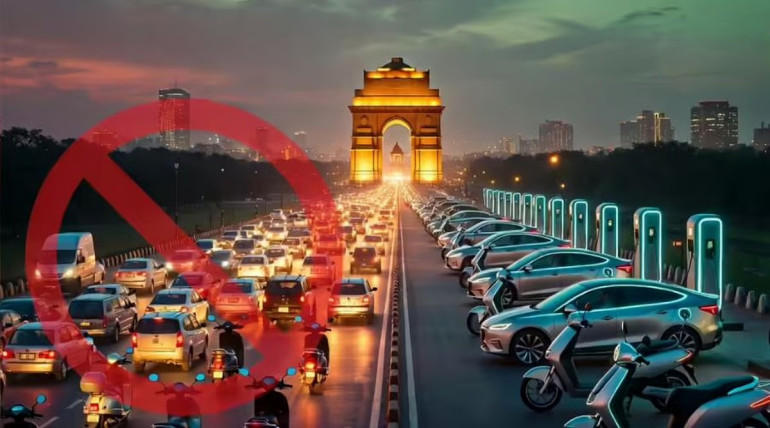
The Delhi Government has introduced the draft Electric Vehicle (EV) Policy 2.0 for the 2026–2030 period, outlining a broad roadmap to accelerate clean mobility adoption in the capital. The policy focuses on reducing vehicular emissions, expanding EV infrastructure, and strengthening the overall ecosystem to support large-scale electrification.
Building upon its 2020 policy, the new draft incorporates findings from the Commission for Air Quality Management (CAQM), which links nearly 23% of Delhi’s winter air pollution to vehicle emissions. Notably, two-wheelers account for a major share of the city’s vehicle population, making them a key target for electrification under the revised policy.
To encourage adoption, the policy proposes a range of financial incentives delivered through a Direct Benefit Transfer (DBT) system. Electric two-wheelers priced up to Rs 2.25 lakh will receive graded incentives over three years, starting at Rs 10,000 per kWh in the first year and tapering thereafter. Similarly, electric auto-rickshaws will be offered incentives starting at Rs 50,000, while electric goods carriers in the four-wheeler category will qualify for benefits of up to Rs 1 lakh in the initial phase.
The draft also introduces scrappage-linked incentives to phase out older, polluting vehicles. Owners of BS-IV and older vehicles can avail financial support when replacing them with electric alternatives, with benefits varying across vehicle categories, including two-wheelers, three-wheelers, goods vehicles, and electric cars within a defined price bracket.
In a major regulatory push, the policy proposes that only electric three-wheelers will be eligible for new registrations starting January 1, 2027, followed by a similar mandate for two-wheelers from April 1, 2028. Additionally, fleet operators and delivery service providers will be restricted from adding new petrol or diesel vehicles from 2026 onward, with limited exceptions for compliant vehicles until the end of that year.
The government has also outlined a complete transition of its own fleet to electric vehicles, while ensuring that all new intra-state buses added to the public transport system are electric, with flexibility to adopt emerging clean technologies such as hydrogen when available.
To support this transition, Delhi Transco Limited (DTL) will serve as the nodal agency for developing charging and battery-swapping infrastructure. The plan includes grid readiness, streamlined approvals through a single-window system, and the rollout of a digital platform for monitoring and implementation. Manufacturers will also be required to contribute by ensuring EV availability and installing public charging stations at their dealerships.
Environmental safeguards form a key component of the policy, with the Delhi Pollution Control Committee (DPCC) tasked with establishing battery collection systems and enforcing compliance with Battery Waste Management Rules, 2022. The framework also emphasizes battery traceability and responsible disposal practices.
The Transport Department will oversee the implementation of the policy, supported by a dedicated EV Cell and funding through a specialized EV Fund. A high-level Apex Committee, led by the Transport Minister, will monitor progress and ensure effective execution. Designed as a fully digital and paperless system, the policy will remain in force until March 31, 2030, with public feedback invited until May 10, 2026.
Related News

Tamil Nadu Unveils Rs 1 Lakh Rooftop Solar Subsidy…
The Tamil Nadu Government has announced a new rooftop solar subsidy of up to Rs…

MERC Clears MSEDCL’s 2,269 MW Distributed Solar Procurement…
The Maharashtra Electricity Regulatory Commission (MERC) has approved the tariffs…

OERC Proposes New 10 MW Distributed Renewable Energy…
The Odisha Electricity Regulatory Commission (OERC) has proposed a new regulatory…