Follow India Renewable Energy News on WhatsApp for exclusive updates on clean energy news and insights
Government Extends Customs Duty Exemptions for Battery and Electronics Manufacturing Equipment Until 2029
Jul 11, 2026
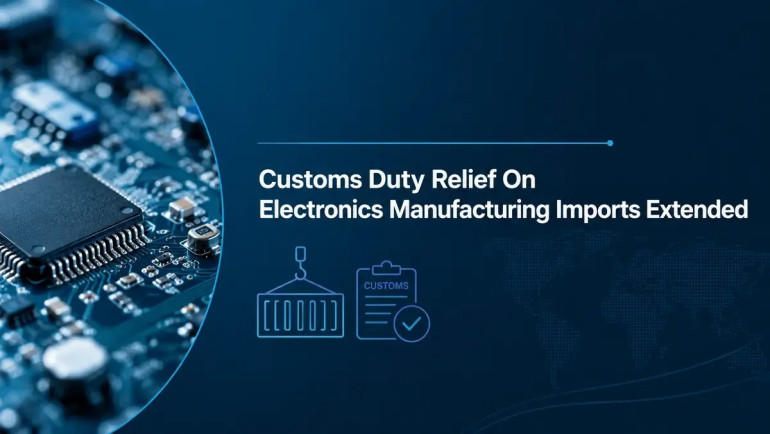
The Central Government has extended basic customs duty (BCD) exemptions on a wide range of machinery, equipment, and components used in electronics and lithium-ion battery manufacturing until March 31, 2029, providing long-term policy support for India's rapidly expanding manufacturing sector. The decision is expected to reduce production costs, encourage fresh investments in advanced manufacturing facilities, and strengthen India's position as a global hub for electronics and clean energy technologies.
The extension was announced through three notifications issued by the Ministry of Finance, which continue customs duty relief on goods used in the manufacture of lithium-ion batteries, display assemblies, and wireless charging modules. The revised exemptions came into effect immediately and are designed to provide manufacturers with greater certainty for long-term capacity expansion and technology investments.
A key feature of the revised policy is the expansion of the list of eligible machinery that can be imported duty-free for lithium-ion battery manufacturing. By lowering the cost of importing specialised production equipment, the government aims to accelerate the establishment of domestic battery manufacturing facilities, improve production efficiency, and support India's transition toward electric mobility and energy storage systems.
The customs duty concessions also cover critical components used in the production of display modules and smartphone wireless charging systems, two segments that have witnessed significant growth under India's electronics manufacturing ecosystem. Reduced import costs for manufacturing inputs are expected to improve the competitiveness of domestically produced electronic products while decreasing reliance on imported finished goods.
The policy extension complements several flagship government initiatives aimed at expanding domestic manufacturing, including the Make in India programme and the Production Linked Incentive (PLI) Scheme for Advanced Chemistry Cell (ACC) battery storage and large-scale electronics manufacturing. Together, these initiatives are encouraging global and domestic manufacturers to establish integrated production facilities in India, strengthen local supply chains, and increase value addition within the country.
The move is particularly significant for India's electric vehicle (EV) and renewable energy sectors, where demand for lithium-ion batteries continues to rise rapidly. Domestic battery manufacturing is expected to play a critical role in supporting EV adoption, grid-scale Battery Energy Storage Systems (BESS), consumer electronics, and renewable energy integration. Lower capital expenditure on manufacturing equipment can improve project viability and accelerate investments across the battery value chain.
Industry stakeholders have welcomed the extension, noting that long-term policy stability is essential for large-scale manufacturing investments that typically require multi-year planning and substantial capital expenditure. The continued duty exemptions are expected to encourage companies to adopt advanced production technologies, expand manufacturing capacity, and improve export competitiveness.
India has emerged as one of the world's fastest-growing electronics manufacturing destinations over the past decade, with smartphones, consumer electronics, semiconductor components, and battery technologies becoming key focus areas for industrial development. The government's continued emphasis on reducing import dependence, promoting domestic manufacturing, and strengthening supply chain resilience is expected to further boost investment and employment across these strategic sectors.
By extending customs duty relief until 2029, the government has provided manufacturers with greater policy certainty while reinforcing its long-term objective of building a globally competitive manufacturing ecosystem for electronics, advanced batteries, and next-generation clean energy technologies.
Related News

Tamil Nadu Unveils Rs 1 Lakh Rooftop Solar Subsidy…
The Tamil Nadu Government has announced a new rooftop solar subsidy of up to Rs…

MERC Clears MSEDCL’s 2,269 MW Distributed Solar Procurement…
The Maharashtra Electricity Regulatory Commission (MERC) has approved the tariffs…
OERC Proposes New 10 MW Distributed Renewable Energy…
The Odisha Electricity Regulatory Commission (OERC) has proposed a new regulatory…