Follow India Renewable Energy News on WhatsApp for exclusive updates on clean energy news and insights
Infineon Launches €5 Billion Smart Power Fab in Germany to Boost AI, EV and Clean Energy Chip Production
Jul 06, 2026
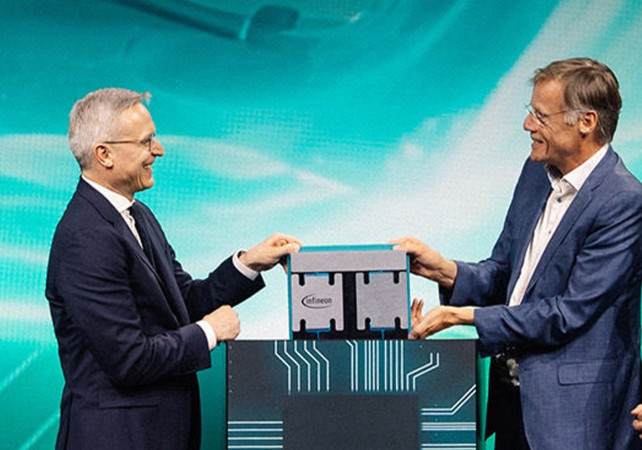
Infineon Technologies AG has inaugurated its 5 billion euro Smart Power Fab in Dresden, Germany, marking the company's largest-ever investment and establishing what it describes as the world's largest manufacturing facility dedicated to intelligent power semiconductors and analog/mixed-signal technologies. The new fabrication plant was completed several months ahead of schedule and is expected to play a critical role in meeting rising global demand for semiconductors used in artificial intelligence (AI), electric vehicles (EVs), renewable energy systems, and industrial automation.
The facility will double Infineon's manufacturing capacity at its Dresden campus while creating approximately 1,000 direct jobs. The expansion strengthens Europe's semiconductor manufacturing capabilities at a time when governments and industries are prioritizing domestic chip production to improve supply chain resilience and reduce dependence on overseas manufacturing. The project also aligns with the European Union's broader ambition to increase its share of global semiconductor production through the European Chips Act.
Infineon CEO Jochen Hanebeck said the new fab comes online at a crucial moment as demand for power semiconductors continues to accelerate. He noted that the facility will help supply critical technologies powering AI data centres, software-defined vehicles, renewable energy infrastructure, and other energy-efficient applications while reinforcing Infineon's leadership in power electronics.
German Chancellor Friedrich Merz described the investment as a strong signal for Germany and Europe as advanced manufacturing hubs. He emphasized that power semiconductors have become a strategic technology supporting the energy transition, next-generation mobility, and AI infrastructure, while also enhancing Europe's technological sovereignty and strengthening critical supply chains.
The new Smart Power Fab has been designed as a highly digitalized manufacturing facility. Infineon used digital twin technology to optimize the factory layout before construction, while AI-driven algorithms assist with process qualification and production management. The Dresden facility is also digitally integrated with Infineon's semiconductor plant in Villach through a "One Virtual Fab" approach, enabling faster process qualification, improved production flexibility, and quicker response to changing market demand.
Power semiconductors manufactured at the facility will support a wide range of high-growth industries. In AI data centres, these chips improve power conversion efficiency, helping reduce electricity losses and lower operating costs as computing workloads continue to expand. In the automotive sector, they are essential components for electric vehicle traction systems, onboard chargers, battery management systems, and advanced electronic control units. The chips are also widely used in solar inverters, wind turbines, industrial motor drives, smart grids, and energy storage systems, where efficient power management directly contributes to lower energy consumption and improved system reliability.
Unlike conventional semiconductor chips that primarily process data, power semiconductors are designed to regulate, convert, and control electrical energy. They enable electricity to move more efficiently through electronic systems, making them a foundational technology for electrification and decarbonization. Industry analysts expect demand for these devices to grow significantly over the coming decade as countries expand renewable energy deployment, electrify transportation, modernize power infrastructure, and build larger AI computing facilities.
The project also incorporates several sustainability measures. According to Infineon, the manufacturing facility operates without natural gas and has been engineered with advanced water recycling systems that return around 90% of process water back into circulation. The closed-loop water management system is also designed to recover up to 45% of the energy used during operations, reducing the plant's overall environmental footprint.
The Dresden expansion further strengthens the Silicon Saxony semiconductor cluster, Europe's largest microelectronics ecosystem, where more than 80,000 people are already employed across semiconductor manufacturing, research, equipment suppliers, and related industries. Studies cited by Infineon indicate that every cleanroom manufacturing job can support several additional jobs throughout the regional supply chain, highlighting the broader economic impact of the investment.
As global demand for AI computing, electrified mobility, and renewable energy infrastructure continues to increase, investments such as Infineon's Smart Power Fab are expected to play a pivotal role in securing semiconductor supply, improving energy efficiency, and supporting Europe's long-term industrial competitiveness. The facility represents one of the continent's most significant recent semiconductor investments and reinforces the growing strategic importance of power electronics in the global clean energy and digital transformation.
Related News

NIT Rourkela Develops AI-Powered Smart Monitoring…
Researchers at the National Institute of Technology (NIT) Rourkela have developed…
INVT Electric India Unveils Advanced Industrial Automation…
INVT Electric India showcased its latest portfolio of industrial automation and…
Andhra Pradesh's Proposed ‘Deemed Distribution Licensee’…
The Andhra Pradesh Government's proposal to grant "deemed distribution licensee"…