Follow India Renewable Energy News on WhatsApp for exclusive updates on clean energy news and insights
International Solar Alliance Seeks Consultants to Develop Rajasthan’s Long-Term Energy Transition Strategy
Aug 09, 2026
The International Solar Alliance (ISA) has invited bids from eligible consulting firms and consortiums to assist the Government of Rajasthan in developing a comprehensive Energy Transition Planning (ETP) framework. The proposed exercise is aimed at creating a long-term roadmap for renewable energy expansion, grid modernisation, energy storage, efficiency improvements and investment mobilisation as Rajasthan prepares for a significant increase in clean-energy capacity.
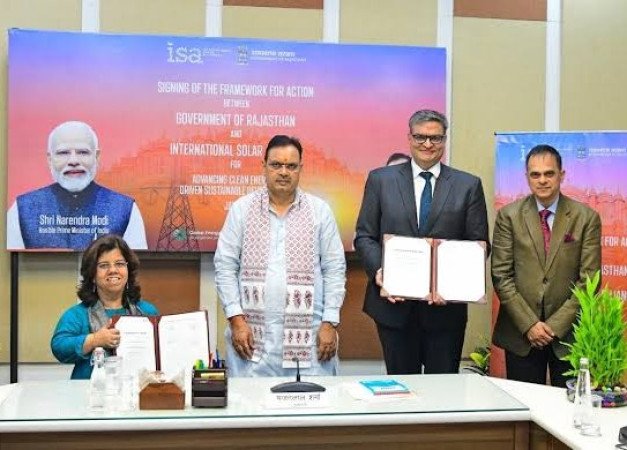
The initiative follows a Framework for Action signed between Rajasthan’s Energy Department and the International Solar Alliance on July 8, 2026. The planning exercise will be undertaken under the supervision of the State Energy Transition Committee constituted by the Rajasthan government. The selected consultant will be expected to develop an integrated strategy that connects renewable-energy deployment with transmission and distribution planning, electricity demand, storage requirements, energy efficiency measures and financing mechanisms.
Rajasthan has been selected for the programme because of its position as one of India's leading renewable-energy markets, particularly in utility-scale solar power. According to the tender document, the state had approximately 43.8 GW of installed renewable-energy capacity as of January 2026, including more than 22.8 GW of solar and around 5.2 GW of wind capacity. Its large solar resource, extensive land availability and growing transmission infrastructure have made Rajasthan a key destination for developers seeking to build large renewable-energy projects.
The scale of Rajasthan's future ambitions makes integrated planning increasingly important. Under the Rajasthan Renewable Energy Policy 2023, the state has set a target of reaching 90 GW of renewable-energy capacity by 2030. The Rajasthan Integrated Clean Energy Policy 2024 outlines an even larger ambition of nearly 125 GW of renewable-energy capacity by 2029-30. Achieving these targets will require not only additional generation capacity but also substantial investments in transmission networks, energy storage, system flexibility and grid management.
The consultancy assignment will therefore extend beyond identifying additional solar and wind projects. The selected agency will be expected to assess the state's future energy requirements and develop coordinated plans for generation, transmission and distribution infrastructure. The study will also examine the role of battery energy storage and other flexibility solutions in managing fluctuations associated with renewable generation, particularly as the share of variable solar and wind power increases.
Another important component will be the identification of implementation-ready projects and investment opportunities. The consultant will be expected to develop project pipelines and support investment mobilisation by identifying suitable financing pathways. This could help Rajasthan convert its broader energy-transition objectives into a structured portfolio of projects that can be taken forward by government agencies, utilities, private developers and financial institutions.
The planning exercise is also expected to address demand-side interventions and energy efficiency. Rajasthan's electricity requirements are likely to evolve as industrial activity expands and sectors such as transport, buildings and manufacturing become increasingly electrified. Planning for these changes alongside renewable generation and grid investments can help reduce infrastructure bottlenecks and improve the overall efficiency and reliability of the state's power system.
The tender places considerable emphasis on technical expertise. Proposals will be evaluated using a 70:30 technical-to-financial weighting, with technical proposals accounting for 70 percent and financial bids for the remaining 30 percent. A bidder will need to obtain at least 70 marks out of 100 in the technical evaluation to qualify for financial consideration. Assessment criteria include experience in integrated energy planning, energy modelling, renewable-energy and grid planning, preparation of detailed project reports, investment pipeline development, stakeholder engagement and institutional coordination.
Joint ventures and consortium arrangements are permitted under the procurement process, allowing firms with complementary expertise to participate. Bidders are expected to demonstrate relevant experience in energy transition, renewable energy, electricity infrastructure and integrated planning, while previous assignments for governments, multilateral institutions and projects involving energy-modelling tools will also be considered.
The procurement schedule provides for a pre-bid meeting on August 10, 2026, with clarification requests to be submitted by August 11. Interested bidders are required to submit their proposals electronically by August 21, 2026. The selected consultant will undertake the assignment over a 12-month period from the commencement date.
For Rajasthan, the exercise comes at a critical stage of its renewable-energy development. The state has already established a substantial clean-energy base, but moving towards a power system capable of accommodating significantly higher renewable penetration will require coordinated investment across generation, transmission, storage, demand management and financing. The ISA-backed planning initiative could provide a framework for aligning these areas and helping Rajasthan move from rapid renewable-capacity addition towards a more integrated and resilient clean-energy system.
Related News
International Solar Alliance Seeks Consultants to…
The International Solar Alliance (ISA) has invited bids from eligible consulting…
Hinduja Renewables Crosses 4 TWh Green Power Generation…
Hinduja Renewables Energy Private Limited (HREPL), the renewable energy arm of the…
Mahavitaran CMD Lokesh Chandra Honoured for Driving…
Lokesh Chandra, Chairman and Managing Director of Maharashtra State Electricity…