Follow India Renewable Energy News on WhatsApp for exclusive updates on clean energy news and insights
JSW Breaks Ground on Green Steel Plant in Andhra Pradesh with 3,850 MW Renewable Energy Project
Jul 06, 2026
Andhra Pradesh has strengthened its position as an emerging hub for sustainable industrial development with the launch of the JSW Rayalaseema Steel Plant and an associated 3,850 MW captive renewable energy project. The integrated development combines large-scale steel manufacturing with dedicated solar and wind power generation, reflecting the growing trend of decarbonising energy-intensive industries through clean electricity.
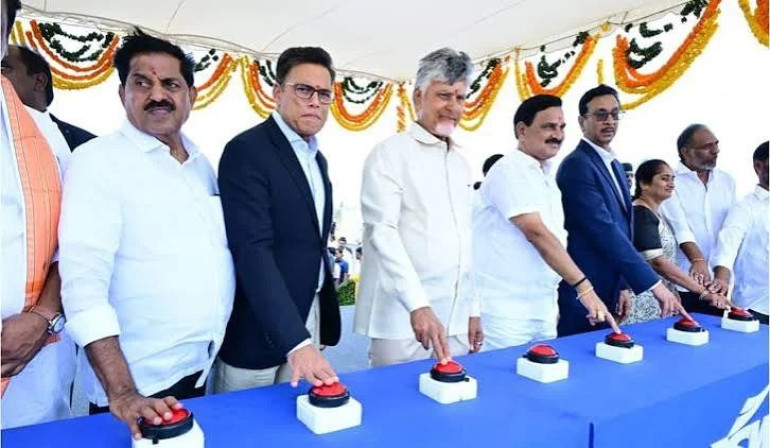
The foundation stone for the project was laid by N. Chandrababu Naidu, alongside Sajjan Jindal and Union Minister Srinivasa Varma at Sunnapurallapalle in Kadapa district. During the event, the state also inaugurated the construction of the JSW Neo Energy Solar Captive Power Project and virtually launched the company's industrial park in Vizianagaram district.
The Rayalaseema Steel Plant will be developed in two phases with an investment of Rs16,350 crore and an annual production capacity of 2 million tonnes (2 MTPA). Supporting the steel facility, JSW Neo Energy will invest Rs20,350 crore to establish a 3,850 MW captive renewable energy portfolio comprising solar and wind power projects. The renewable power generated will primarily supply electricity to the steel plant, enabling lower-carbon steel production while reducing dependence on conventional fossil fuel-based power.
Together, the steel manufacturing facility and renewable energy project are expected to create around 2,700 direct jobs, while contributing significantly to industrial growth in the Rayalaseema region. In addition, JSW is investing Rs531 crore to develop a 1,166-acre industrial park in Vizianagaram district, offering plug-and-play infrastructure for future manufacturing and industrial investments.
Speaking at the ceremony, Chief Minister N. Chandrababu Naidu described the project as a milestone for Rayalaseema's industrial development and said it fulfils a long-standing aspiration for large-scale manufacturing in the region. He highlighted Rayalaseema's growing importance across sectors such as electric mobility, defence manufacturing, electronics, horticulture, mining, and renewable energy, supported by investments in infrastructure and improved water availability.
The Chief Minister also emphasized that the new steel plant will operate using renewable energy, aligning with Andhra Pradesh's strategy to promote cleaner industrial production. He referenced other major investments planned for the state's steel sector, including the proposed Rs1.35 lakh crore integrated steel project by ArcelorMittal in Anakapalle and the ongoing revival of the Rashtriya Ispat Nigam Limited-operated Visakhapatnam Steel Plant, supported by Rs11,440 crore in financial assistance from the Central Government.
Naidu reaffirmed the state's commitment to providing critical infrastructure—including road, rail, port connectivity, and water supply—to facilitate large industrial investments. He added that Andhra Pradesh is leveraging its mineral resources and logistics network to attract industries while ensuring long-term economic development and employment generation.
During the event, Sajjan Jindal announced that the company intends to expand the Rayalaseema Steel Plant beyond its initial 2 MTPA capacity. He also revealed plans for nearly Rs50,000 crore of investments across Andhra Pradesh over the coming years, with the potential to create employment opportunities for approximately 50,000 people across multiple sectors.
Globally, the steel industry accounts for roughly 7–9% of energy-related carbon dioxide (CO?) emissions, making it one of the most carbon-intensive industrial sectors. Increasingly, steel manufacturers are investing in renewable energy, green hydrogen, electric arc furnaces, and energy-efficient technologies to reduce emissions and comply with evolving sustainability standards. Captive renewable energy projects such as the one planned for the Rayalaseema Steel Plant can significantly lower the carbon intensity of steel production while improving long-term energy security and reducing exposure to volatile electricity prices.
The integrated steel and renewable energy development represents one of Andhra Pradesh's largest green industrial investments to date and reflects a broader shift toward combining renewable power with heavy manufacturing. As India advances toward its target of 500 GW of non-fossil fuel-based installed electricity capacity by 2030 and pursues net-zero emissions by 2070, projects that integrate clean energy with industrial production are expected to play an increasingly important role in supporting sustainable economic growth.
Related News
Himachal Pradesh Commissions 500 kW Solar Plant in…
Himachal Pradesh has strengthened its clean energy and rural development initiatives…
SJVN Commissions India's Largest 1 GW Single-Site…
State-owned power producer SJVN Limited has commissioned a 1,000 MW (1 GW) Domestic…
JSW Breaks Ground on Green Steel Plant in Andhra Pradesh…
Andhra Pradesh has strengthened its position as an emerging hub for sustainable…