Follow India Renewable Energy News on WhatsApp for exclusive updates on clean energy news and insights
SJVN Commissions India's Largest 1 GW Single-Site DCR Solar Project in Rajasthan
Jul 07, 2026
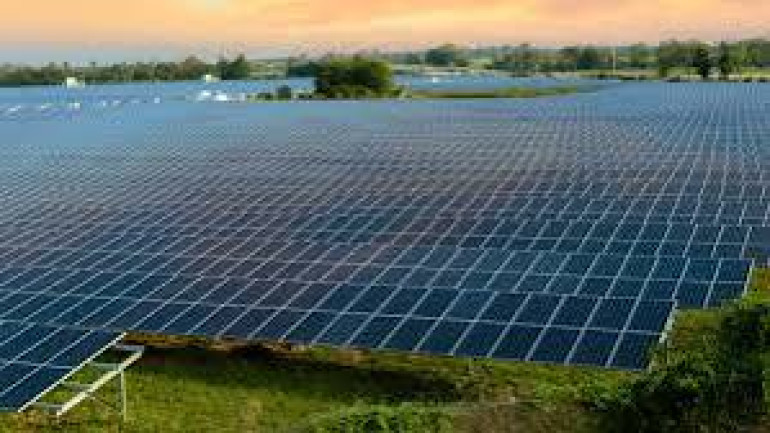
State-owned power producer SJVN Limited has commissioned a 1,000 MW (1 GW) Domestic Content Requirement (DCR) solar power project in Rajasthan's Bikaner district, marking a significant milestone in India's renewable energy expansion. Developed through its wholly owned subsidiary, SJVN Green Energy Limited (SGEL), the project is the country's largest single-location solar installation executed under the DCR category, highlighting India's growing domestic manufacturing capabilities in the clean energy sector.
Constructed with an investment of approximately Rs 5,492 crore across nearly 5,000 acres, the solar project has been designed to strengthen India's renewable energy capacity while supporting the government's Make in India and Atmanirbhar Bharat initiatives. By relying extensively on domestically manufactured solar equipment, the project is expected to reduce dependence on imported components and promote the growth of India's solar manufacturing ecosystem.
According to SJVN, the project is expected to generate around 2,454.84 million units (MU) of electricity during its first year of operation and nearly 56,482 MU of clean energy over its estimated 25-year operational life. The generated electricity will be supplied to Rajasthan (500 MW), Uttarakhand (200 MW) and Jammu & Kashmir (300 MW) under long-term power purchase arrangements, helping these states meet their rising electricity demand through renewable sources.
The project is also expected to deliver significant environmental benefits by preventing an estimated 2.79 billion kilograms of carbon dioxide emissions over its operational lifespan. Large-scale solar projects such as this play an important role in supporting India's climate commitments, reducing dependence on fossil fuels and accelerating the country's transition toward a low-carbon power sector.
Prime Minister Narendra Modi formally inaugurated the project from Pachpadra in Rajasthan during an event attended by several senior leaders, including Haribhau Kisanrao Bagde, Bhajan Lal Sharma, Manohar Lal Khattar, Hardeep Singh Puri, Arjun Ram Meghwal, Diya Kumari and Prem Chand Bairwa. Senior officials from SJVN and SJVN Green Energy also participated in the inauguration virtually.
A defining feature of the Bikaner project is its extensive use of domestically produced solar equipment. The facility has been built using approximately 2.422 million DCR-compliant solar modules and nearly 17.5 billion indigenous solar cells, making it one of the largest renewable energy projects to utilize Indian-manufactured photovoltaic components. The approach aligns with the government's objective of strengthening domestic manufacturing, encouraging local value addition and creating a self-reliant renewable energy supply chain.
Beyond electricity generation, the project has contributed to the economic development of the region by creating more than 2,000 direct and indirect employment opportunities during the construction and commissioning phases. It has also supported the development of supporting infrastructure, including internal roads, transmission facilities and associated utilities, improving connectivity and boosting economic activity in the Bikaner region.
India has been rapidly expanding its renewable energy portfolio as it works toward achieving 500 GW of non-fossil fuel-based installed electricity capacity by 2030. Utility-scale solar projects such as the Bikaner plant are expected to play a crucial role in meeting this target by supplying affordable clean electricity, improving energy security and reducing greenhouse gas emissions.
SJVN, a Navratna Central Public Sector Enterprise under the Ministry of Power, currently has an installed power generation capacity of 4,196.5 MW across hydro, solar and wind projects, in addition to operating transmission infrastructure. The commissioning of the Bikaner Solar Power Project further strengthens the company's renewable energy portfolio and reinforces its long-term strategy of supporting India's clean energy transition through large-scale sustainable power generation.
Related News
Himachal Pradesh Commissions 500 kW Solar Plant in…
Himachal Pradesh has strengthened its clean energy and rural development initiatives…
SJVN Commissions India's Largest 1 GW Single-Site…
State-owned power producer SJVN Limited has commissioned a 1,000 MW (1 GW) Domestic…
JSW Breaks Ground on Green Steel Plant in Andhra Pradesh…
Andhra Pradesh has strengthened its position as an emerging hub for sustainable…