Follow India Renewable Energy News on WhatsApp for exclusive updates on clean energy news and insights
Navitas Solar and Caelux Partner to Manufacture 5 GW of Next-Generation Perovskite-TOPCon Solar Modules in India
Jul 23, 2026
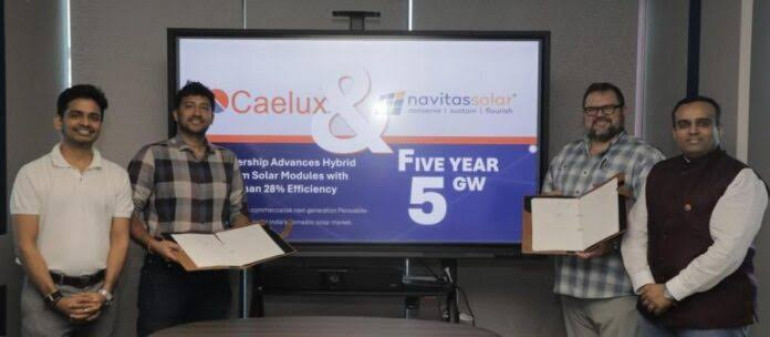
Indian solar module manufacturer Navitas Solar has entered into a five-year strategic partnership with US-based Caelux Corporation to manufacture 5 GW of high-efficiency perovskite-TOPCon Hybrid Tandem solar modules in India. The collaboration aims to commercialise one of the solar industry's most promising next-generation technologies, with commercial production targeted by 2028, reinforcing India's ambitions to become a global hub for advanced photovoltaic manufacturing.
Under the agreement, Navitas Solar will integrate Caelux's proprietary perovskite energy-producing glass with its N-Type TOPCon solar module technology to produce Hybrid Tandem modules capable of achieving conversion efficiencies of up to 28 percent or higher. This represents a significant improvement over conventional silicon-based TOPCon modules, which typically achieve efficiencies of around 25 percent, enabling greater electricity generation from the same installation area.
Hybrid Tandem solar modules combine two photovoltaic materials—traditional crystalline silicon and perovskite—within a single module. While the silicon layer efficiently absorbs lower-energy sunlight, the perovskite layer captures higher-energy wavelengths, allowing more of the solar spectrum to be converted into electricity. This tandem architecture improves energy yield, enhances land-use efficiency and has the potential to reduce the levelised cost of electricity (LCOE) for utility-scale, commercial and rooftop solar installations.
The partnership comes as India continues to rapidly expand its renewable energy capacity. The country has emerged as one of the world's fastest-growing solar markets, with installed solar power capacity crossing 150 GW, while the Government has set a target of achieving 500 GW of non-fossil fuel-based installed electricity capacity by 2030. Meeting this objective will require not only accelerated deployment of solar projects but also continuous improvements in module efficiency, domestic manufacturing capabilities and technology innovation.
The collaboration is also expected to strengthen India's domestic solar manufacturing ecosystem by supporting greater value addition under the Approved List of Models and Manufacturers (ALMM) framework. As India seeks to reduce dependence on imported photovoltaic components and build a fully integrated solar supply chain, advanced technologies such as perovskite-silicon tandem cells could play an important role in enhancing the global competitiveness of Indian-made solar products.
Perovskite solar technology has attracted significant global attention in recent years due to its potential to deliver substantially higher efficiencies at lower manufacturing costs compared with conventional silicon-only cells. Although commercial deployment is still at an early stage, several leading global manufacturers and research institutions are investing heavily in tandem solar technologies, which are widely regarded as the next major evolution in photovoltaic innovation.
Navitas Solar currently operates multi-gigawatt manufacturing facilities and has established capabilities across solar module production, encapsulant manufacturing and engineering, procurement and construction (EPC) services. The partnership with Caelux expands the company's technology roadmap by introducing perovskite-based manufacturing into its product portfolio and positions it among the early adopters of tandem solar technology in India.
With commercial production targeted for 2028, the collaboration is expected to accelerate the adoption of next-generation high-efficiency solar modules across utility-scale, commercial and industrial (C&I), and distributed renewable energy projects. As global demand shifts towards higher-performance photovoltaic technologies, the partnership could strengthen India's role in the international clean energy supply chain while supporting the country's long-term energy security, manufacturing self-reliance and decarbonisation objectives.
Related News

Navitas Solar and Caelux Partner to Manufacture 5…
Indian solar module manufacturer Navitas Solar has entered into a five-year strategic…
Avaada Joins ALMM List-II with 610 MW TOPCon Cell…
India's domestic solar manufacturing ecosystem has received another boost as the…

Rayzon Solar Partners with Caelux to Develop 5 GW…
Indian photovoltaic manufacturer Rayzon Solar has entered into a strategic five-year…