Follow India Renewable Energy News on WhatsApp for exclusive updates on clean energy news and insights
Rajasthan’s “150 Free Units” Claim Explained: Separating Fact from Misconception
Dec 24, 2025
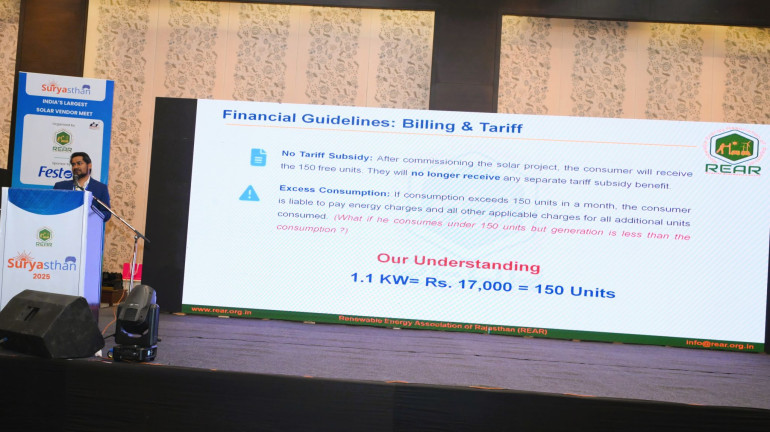
There is increasing confusion in Rajasthan regarding the announcement of “150 free electricity units” linked to the installation of a 1.1 kW rooftop solar system, along with an additional subsidy of Rs17,000.
Based on current understanding, this mechanism functions in the same manner as the PM Surya Ghar: Muft Bijli Yojana, which refers to 300 free units. However, it is important to clarify what “free units” actually mean in this context.
The electricity is not supplied free by the DISCOM. Instead, the benefit arises from self-generation through rooftop solar, supported by government subsidies.
For example, when a consumer installs a 3 kW rooftop solar system, the system can generate approximately 300 units per month. These units are considered “free” because:
- They are produced by the consumer’s own solar system
- The capital cost is partially offset by government subsidy
Applying the same logic in Rajasthan: The Rs17,000 additional subsidy is provided for installing a 1.1 kW solar system, which can generate roughly 150 units per month.
In simple terms:
1.1 kW system + Rs17,000 subsidy = ~150 self-generated units per month
There are no free electricity units being supplied directly by the utility. The financial benefit comes from reduced electricity bills due to own solar generation, enabled by upfront subsidy support.
To prevent misinformation, manage consumer expectations, and reduce on-ground confusion, it is crucial that DISCOMs issue a clear and formal clarification. This will help ensure:
- Consumers clearly understand the benefit structure
- Vendors communicate accurately and responsibly
- Trust in rooftop solar schemes is maintained
Clear communication leads to faster adoption—and a stronger rooftop solar ecosystem.
Related News
AXITEC Energy India Supplies 600 Wp Bifacial Modules…
AXITEC Energy India, the Indian subsidiary of Germany-headquartered AXITEC Energy…
Kolkata Metro Expands Renewable Energy Footprint with…
Metro Railway has commissioned a 500 kWp rooftop solar power plant at Jessore Road…
Odisha to Integrate PM Surya Ghar Scheme with Housing…
The Odisha Government has announced plans to integrate the PM Surya Ghar: Muft Bijli…