Follow India Renewable Energy News on WhatsApp for exclusive updates on clean energy news and insights
Telangana Introduces 2025 Rooftop Solar Policy, Expands Net Metering & Shared Energy Models
Nov 23, 2025
At the ISA SIDS leadership session during UNFCCC CoP30 in Brazil, India called for strengthened global cooperation to enhance energy security for Small Island Developing States (SIDS), highlighting its clean-energy progress and offering scalable rooftop, agriculture, and storage models.
India has urged the global community to intensify joint action to secure the energy future of Small Island Developing States (SIDS), speaking at the ISA SIDS Leadership Session held on the sidelines of CoP30 in Belem, Brazil.
Union Environment Minister Bhupender Yadav, addressing ministers and senior representatives from SIDS and other ISA member countries, emphasised that solar energy can serve as a powerful tool to build resilience, cut energy costs, and reduce reliance on imported fossil fuels.
Held under the theme “Uniting Islands, Inspiring Action – Leadership for Energy Security,” the session explored the severe vulnerabilities faced by SIDS, including extreme climate risks, high fuel prices, and fragile energy systems. Yadav noted that the ISA SIDS Platform has been created specifically to address these challenges through a strong digital and financial ecosystem that accelerates solar deployment, standardised procurement, blended finance solutions, and capacity-building initiatives.
India’s Clean-Energy Milestones Highlighted
Yadav outlined India’s significant progress in the clean-energy transition, announcing that the nation has crossed 500 GW of installed electricity capacity, with more than half coming from non-fossil fuel sources. India — now the fourth-largest renewable energy producer and the third-largest solar power generator globally — has met its target of 50% non-fossil capacity five years ahead of schedule. He attributed this achievement to Prime Minister Narendra Modi’s focus on “scale, speed, and public participation.”
Rooftop Solar Success & Grassroots Impact
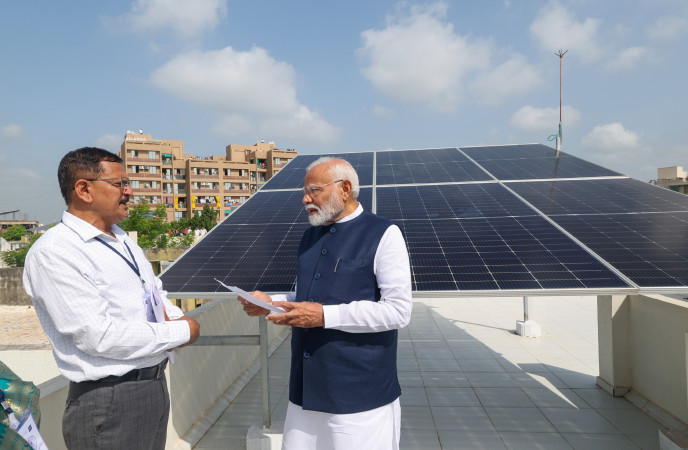
The Minister spotlighted the PM Surya Ghar Rooftop Solar Programme, sharing the story of a schoolteacher whose monthly stress over electricity bills has turned into excitement about sunshine and income generation. With over 20 lakh households already adopting rooftop solar, Yadav described the initiative as providing “freedom for every household.”
Solar Agriculture & Rural Empowerment
Yadav also highlighted the expansion of solar solutions in agriculture, calling it “a new dawn” for farmers. Solar pumps and solarised feeders have helped ensure reliable daytime electricity, eliminate diesel dependence, and improve income stability. He also referenced efforts to electrify remote and forested regions through the PM JANMAN scheme, empowering communities traditionally left out of the energy grid.
Large-Scale Energy Storage for Climate Resilience
Discussing India’s push into advanced energy storage, the Minister said that the country is developing some of the world’s largest solar-plus-battery storage projects, including a landmark installation in Ladakh capable of storing enough energy to power an entire city. He noted that similar models could greatly benefit SIDS by reducing diesel imports and building climate-resilient energy systems.
India’s Commitment to ISA & Global Solar Cooperation
Reaffirming India’s leadership role in the International Solar Alliance, Yadav described ISA as a “global solar family” connecting more than 124 countries. He said the alliance continues to accelerate project preparation, mobilise financing, generate local employment, and position solar energy as the most reliable and preferred clean-power solution.
Representatives from island nations welcomed India’s leadership and praised its advances in the renewable energy sector. They emphasised the urgent need for climate-resilient energy infrastructure, noting that strengthening energy systems is both a climate necessity and a socio-economic imperative. Delegates expressed optimism that the SIDS Platform would support them through feasibility studies, skills development, and improved access to climate finance.
Related News
AXITEC Energy India Supplies 600 Wp Bifacial Modules…
AXITEC Energy India, the Indian subsidiary of Germany-headquartered AXITEC Energy…
Kolkata Metro Expands Renewable Energy Footprint with…
Metro Railway has commissioned a 500 kWp rooftop solar power plant at Jessore Road…
Odisha to Integrate PM Surya Ghar Scheme with Housing…
The Odisha Government has announced plans to integrate the PM Surya Ghar: Muft Bijli…