Follow India Renewable Energy News on WhatsApp for exclusive updates on clean energy news and insights
The AI Boom Is Reshaping Global Power Demand. Here's Why Data Centers Have Become the World's Next Energy Challenge
Jun 29, 2026
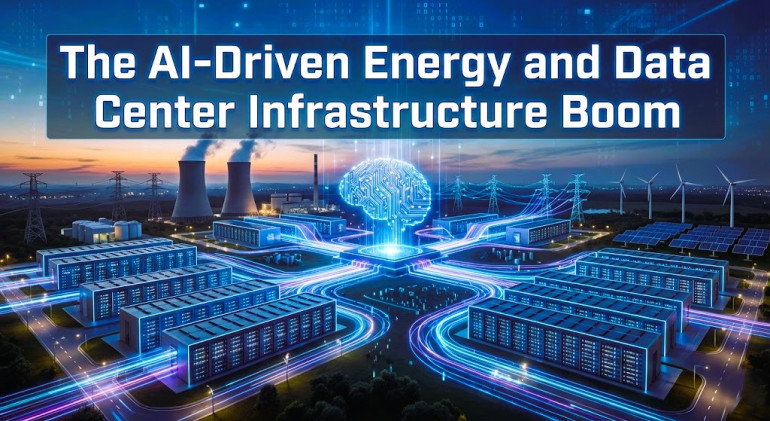
Artificial Intelligence is transforming industries at an unprecedented pace, but behind every chatbot response, AI-generated image and autonomous software lies a physical infrastructure that few people ever see—the AI data center. As companies race to build larger and more powerful AI models, these facilities have become the backbone of the digital economy, consuming enormous amounts of electricity, water and computing resources. Their rapid expansion is now reshaping global energy markets and forcing utilities, governments and technology companies to rethink how future electricity will be generated and delivered.
Unlike traditional data centers that primarily host websites, cloud applications and business software, AI data centers are purpose-built for high-performance computing. Instead of relying mainly on conventional processors, they contain thousands—or even hundreds of thousands—of Graphics Processing Units (GPUs) and AI accelerators that work simultaneously to train and run complex machine learning models. These processors perform trillions of calculations every second, enabling applications ranging from conversational AI and autonomous vehicles to scientific research and medical discoveries.
However, this computing power comes at a significant energy cost.
According to the International Energy Agency (IEA), data centers consumed approximately 415 terawatt-hours (TWh) of electricity globally in 2024, accounting for around 1.5 percent of worldwide electricity demand. With AI adoption accelerating across nearly every sector, the agency projects electricity consumption from data centers could more than double to around 945 TWh by 2030, making them one of the fastest-growing sources of power demand globally.
Inside an AI data center, electricity follows a carefully engineered path. Power enters the facility through high-voltage transmission lines before passing through transformers, backup power systems and sophisticated electrical distribution networks. Every server rack houses dozens of AI processors connected through ultra-fast networking equipment that allows thousands of chips to communicate with one another in real time. Because these processors operate continuously during AI training and inference, they generate tremendous amounts of heat, making cooling systems just as critical as the computing hardware itself.
The IEA estimates that servers and AI accelerators account for nearly 60 percent of a modern AI data center's electricity consumption, while cooling systems represent another major share. Older facilities may use more than 30 percent of their total electricity solely for cooling, whereas newer hyperscale campuses have significantly improved efficiency through advanced thermal management technologies.
This growing power requirement is changing how technology companies think about energy. Rather than simply purchasing electricity from local utilities, many are becoming some of the world's largest investors in renewable energy. Long-term Power Purchase Agreements (PPAs) have enabled companies such as Google, Microsoft, Amazon and Meta to finance large-scale wind and solar projects while securing stable electricity supplies for their expanding cloud and AI operations. According to the IEA, these companies have collectively contracted nearly 50 gigawatts of renewable energy capacity, making the technology sector one of the biggest corporate buyers of clean power worldwide.
Renewable energy alone, however, cannot solve every challenge. Solar panels generate electricity only during daylight hours, while wind generation depends on weather conditions. Since AI data centers operate around the clock, companies are increasingly investing in Battery Energy Storage Systems (BESS), which store excess renewable electricity and supply power when renewable generation declines. Batteries also help stabilize the grid and reduce stress during periods of peak electricity demand.
Another technology attracting renewed attention is nuclear energy. Several major technology companies have announced partnerships or investments aimed at securing future electricity from advanced nuclear reactors and Small Modular Reactors (SMRs). Unlike renewable sources that depend on environmental conditions, nuclear power provides continuous carbon-free electricity, making it particularly attractive for facilities that cannot tolerate interruptions in power supply. While commercial deployment of many SMR technologies is still several years away, industry analysts believe they could become an important part of powering next-generation AI infrastructure.
Geothermal energy is also emerging as a promising option. By harnessing heat stored beneath the Earth's surface, geothermal plants can generate reliable electricity throughout the day without weather-related fluctuations. Companies are increasingly evaluating enhanced geothermal technologies as they search for stable, low-carbon energy sources capable of supporting hyperscale data centers.
Despite rapid progress in renewable and alternative energy technologies, natural gas continues to play an important role in meeting immediate electricity needs. In regions where grid infrastructure cannot expand quickly enough, some developers are considering dedicated natural gas generation to provide reliable power while longer-term clean energy projects are built. Industry experts view this as a transitional solution rather than a permanent strategy, with many companies maintaining ambitious targets to reduce carbon emissions over the coming decades.
Power is only part of the equation. Water has become another critical resource for AI infrastructure. Many large facilities rely on water-based cooling systems to remove heat generated by high-density computing equipment. As awareness of water scarcity grows, operators are investing in closed-loop cooling systems, liquid cooling technologies and water recycling solutions to reduce freshwater consumption while maintaining optimal operating temperatures.
Technology companies are also working to make AI itself more energy efficient. Chip manufacturers, including NVIDIA, AMD and Intel, continue to develop processors capable of delivering significantly more computing performance for every watt of electricity consumed. At the same time, researchers are improving AI software, enabling models to complete tasks with fewer computations and lower energy requirements.
Yet perhaps the greatest challenge lies beyond the walls of the data center. Building a modern AI campus can often take less time than expanding the transmission lines, substations and generating capacity required to power it. In many countries, electricity infrastructure is struggling to keep pace with the unprecedented demand created by artificial intelligence. Utilities are therefore accelerating investments in grid modernization, energy storage and renewable generation to ensure reliable electricity supplies for both digital infrastructure and consumers.
The rise of AI is no longer only a technology story—it is increasingly an energy story. Every breakthrough in artificial intelligence depends on a vast physical network of power plants, transmission systems, cooling technologies and renewable energy projects working together behind the scenes. As AI continues to reshape economies and industries, the race to build smarter, cleaner and more resilient data centers is expected to become one of the defining energy challenges of the coming decade.
Official Resources
Related News

NIT Rourkela Develops AI-Powered Smart Monitoring…
Researchers at the National Institute of Technology (NIT) Rourkela have developed…

INVT Electric India Unveils Advanced Industrial Automation…
INVT Electric India showcased its latest portfolio of industrial automation and…
Andhra Pradesh's Proposed ‘Deemed Distribution Licensee’…
The Andhra Pradesh Government's proposal to grant "deemed distribution licensee"…