Follow India Renewable Energy News on WhatsApp for exclusive updates on clean energy news and insights
India Must Gear Up for 300 GW Peak Power Demand in 2027, Says Power Minister; Energy Storage to Drive Next Phase of Clean Energy Growth
Jul 10, 2026
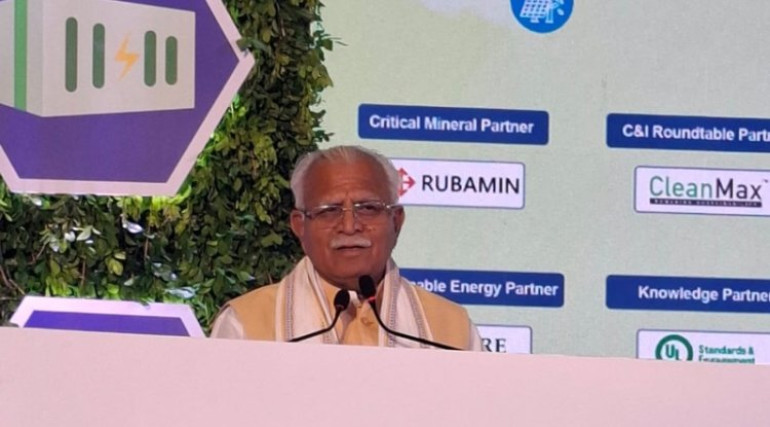
India must prepare to meet a peak electricity demand of nearly 300 GW next year, driven by the rapid expansion of data centres, artificial intelligence (AI), electric vehicles (EVs), and rising industrial electrification, Union Power Minister Shri Manohar Lal said while addressing the 12th India Energy Storage Week (IESW) 2026 at Yashobhoomi, New Delhi. Stressing that energy storage has become central to the country's energy transition, the minister said India must significantly expand its storage infrastructure to ensure reliable power availability as renewable energy capacity continues to grow.
The minister noted that India's peak power demand has already reached around 271 GW, while the country's available generation capacity has increased to approximately 284 GW, enabling it to meet rising electricity requirements. He highlighted the remarkable transformation of the power sector over the past decade, with the nation's installed generation capacity increasing from 249 GW in 2014 to nearly 445 GW, while non-fossil fuel capacity has grown from 81 GW to around 291 GW. Solar power has witnessed particularly rapid growth, expanding from about 3 GW to nearly 137 GW, making India one of the world's fastest-growing solar markets.
Emphasising the importance of energy storage, Shri Manohar Lal said the traditional model of generating and consuming electricity simultaneously is evolving. Technologies such as Battery Energy Storage Systems (BESS) and Pumped Storage Projects (PSPs) are enabling electricity generated during periods of high renewable output to be stored and supplied during peak demand or when solar and wind generation declines. He noted that while India has decades of experience with pumped hydro storage, the country is now rapidly scaling battery storage to support round-the-clock renewable energy integration and improve overall grid flexibility.
The minister also reiterated the government's commitment to achieving net-zero carbon emissions by 2070, stating that domestic manufacturing will play a crucial role in building a resilient clean energy ecosystem. He called for greater emphasis on the 'Make in India' and 'Vocal for Local' initiatives, encouraging the domestic production of solar cells, battery systems, energy storage containers, and other critical clean energy components. According to him, strengthening local manufacturing will reduce import dependence, improve supply chain security, and enhance India's long-term energy independence.
Highlighting India's growing international clean energy ambitions, the minister referred to the 'One Sun, One World, One Grid' initiative, which aims to develop cross-border renewable energy connectivity. He mentioned proposals for a 1,600-kilometre subsea transmission link connecting India and the United Arab Emirates, along with future electricity interconnections with Sri Lanka, Singapore, and Europe, reinforcing India's vision of becoming a global hub for clean energy cooperation.
The event also featured insights from industry leaders on the rapid evolution of India's energy storage sector. Vinayak Walimbe, Managing Director of Customised Energy Solutions, said the country has witnessed a significant rise in battery energy storage deployment and manufacturing announcements, positioning India among the emerging global leaders in the sector. Meanwhile, Central Electricity Authority (CEA) Chairperson Ghanshyam Prasad stated that India is targeting around 160 GW of energy storage capacity by 2035, comprising both battery storage and pumped hydro projects, to support higher renewable energy penetration and ensure reliable 24x7 electricity supply.
Organised by the India Energy Storage Alliance (IESA), the three-day India Energy Storage Week (IESW) 2026 brought together policymakers, utilities, manufacturers, technology providers, and investors to discuss advancements in battery technologies, gigafactory development, grid modernisation, battery recycling, supply chain resilience, and energy storage policies. The event reflects the growing importance of energy storage as India accelerates its transition towards a cleaner, more reliable, and self-reliant power system.
Related News
Bihar Unveils Rs 1.40 Lakh Crore Energy Investment…
The Government of Bihar has presented an ambitious roadmap for transforming the…
GK Energy Revenue Jumps 71% in Q1 FY27 as Renewable…
GK Energy, a decentralised renewable energy infrastructure company focused on solar…
Siemens Energy India Q3 FY26 Revenue Surges 39.3%…
Siemens Energy India Ltd. delivered a strong financial performance in the third…