Follow India Renewable Energy News on WhatsApp for exclusive updates on clean energy news and insights
Rajasthan Becomes First State to Partner with International Solar Alliance on Comprehensive Clean Energy Transition Plan
Jul 10, 2026
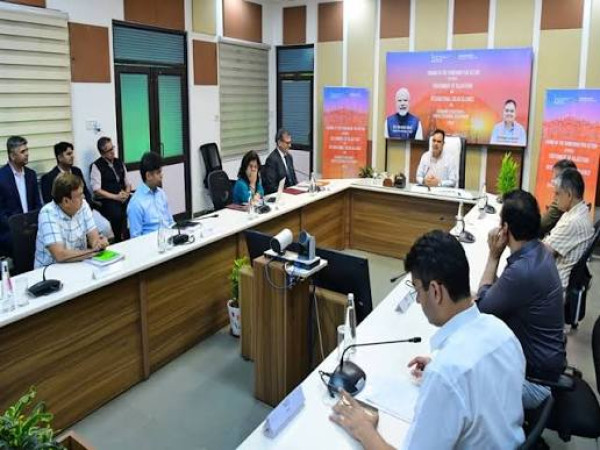
Rajasthan has become the first Indian state to sign a Framework for Action – Advance Clean Energy, Driven Sustainable Development with the International Solar Alliance (ISA), marking a significant milestone in India's clean energy journey. The partnership aims to accelerate the state's energy transition through renewable energy expansion, grid modernisation, digitalisation, energy storage, and policy reforms while strengthening Rajasthan's position as one of the country's leading renewable energy hubs.
The framework agreement was signed by Aarti Dogra, Secretary, Energy Department, Government of Rajasthan, and Ashish Khanna, Director General, International Solar Alliance, in the presence of Chief Minister Bhajan Lal Sharma at the Chief Minister's residence in Jaipur. Under the collaboration, ISA will assist Rajasthan in preparing a comprehensive Energy Transition Plan for 2030–2035, focusing on scaling up renewable energy capacity, modernising transmission and distribution infrastructure, expanding energy storage, improving energy efficiency, promoting demand-side management, and strengthening institutional capacity through technical support and policy guidance.
A key component of the partnership is the adoption of advanced digital technologies to improve power system management. ISA will support the implementation of an Artificial Intelligence (AI)-enabled Digital Twin pilot project at Ajmer Vidyut Vitran Nigam, which is expected to enhance electricity demand forecasting, optimise network planning, facilitate greater integration of renewable energy, and improve the overall reliability and efficiency of power distribution. Digital Twin technology creates a virtual representation of the electricity network, enabling utilities to simulate operating conditions and make data-driven decisions before implementing changes in the field.
Speaking on the occasion, Chief Minister Bhajan Lal Sharma said the agreement aligns with India's global leadership in climate action and supports the vision of achieving sustainable economic growth through clean energy. He highlighted Rajasthan's vast renewable energy potential, stating that the state has set an ambitious target of developing 125 GW of clean energy capacity under the Rajasthan Integrated Clean Energy Policy. He also noted that more than 4 GW of solar capacity has already been deployed under the PM-KUSUM scheme, enabling daytime electricity supply for farmers across 26 districts and reducing dependence on conventional power sources.
The Chief Minister further emphasized that strengthening transmission infrastructure, expanding grid capacity, deploying battery energy storage systems, and promoting smart grid technologies will be essential for integrating higher shares of renewable energy into Rajasthan's power system. He also directed officials to accelerate the implementation of key central government initiatives, including the PM Surya Ghar: Muft Bijli Yojana, the Revamped Distribution Sector Scheme (RDSS), the Green Energy Corridor, and ongoing battery energy storage projects to improve electricity reliability and distribution efficiency.
ISA Director General Ashish Khanna described Rajasthan as the first Indian state to enter into such a comprehensive framework with the alliance, highlighting the state's progressive renewable energy policies and rapidly expanding solar sector. Beyond infrastructure development, the collaboration will also facilitate technical training, knowledge exchange, and capacity-building programmes for engineers and energy officials through ISA's international network, helping Rajasthan adopt global best practices in clean energy planning and implementation.
The agreement reflects the growing importance of integrated energy planning as India moves toward its target of 500 GW of non-fossil fuel electricity capacity by 2030 and its long-term commitment to achieving net-zero emissions by 2070. By combining large-scale renewable energy deployment with digital technologies, modern grid infrastructure, and energy storage, Rajasthan is positioning itself to play a pivotal role in India's transition to a cleaner, smarter, and more resilient power system.
Related News
International Solar Alliance Seeks Consultants to…
The International Solar Alliance (ISA) has invited bids from eligible consulting…
Hinduja Renewables Crosses 4 TWh Green Power Generation…
Hinduja Renewables Energy Private Limited (HREPL), the renewable energy arm of the…
Mahavitaran CMD Lokesh Chandra Honoured for Driving…
Lokesh Chandra, Chairman and Managing Director of Maharashtra State Electricity…